




Detroit has always been a city defined by motion. It built the automobile industry, helped pioneer the modern highway system, and created global manufacturing. Today, that legacy is evolving — upward.
At Michigan Central and Newlab, a new era of mobility is taking shape: one that combines drones, digital airways, real-time data, infrastructure planning, and real-world deployment. What was once science fiction is now being tested above Detroit’s skyline.
Detroitisit sat down with Matthew Whitaker, Director of the Mobility Innovation Platform at Michigan Central, Keith Miao, Founder and CEO of Birdstop, and Rich Fahle, VP of Marketing at Airspace Link, to explore how Detroit is building the systems — and standards — that could define aerial mobility across the country.
Building Infrastructure for the Sky
We tend to think of infrastructure as something that lives on the ground — pavement, intersections, signage, curbs. But what happens when that framework needs to live above us?
“There is a lot of complexity here,” says Whitaker. “For delivery, we need to understand whether drones will follow roadways or fly point-to-point. And how they might move in multiple directions at different heights. We need planning and infrastructure for take off and landing points. What we’re doing here in Detroit is helping identify the right way to do all of that – we’re creating the standards.”

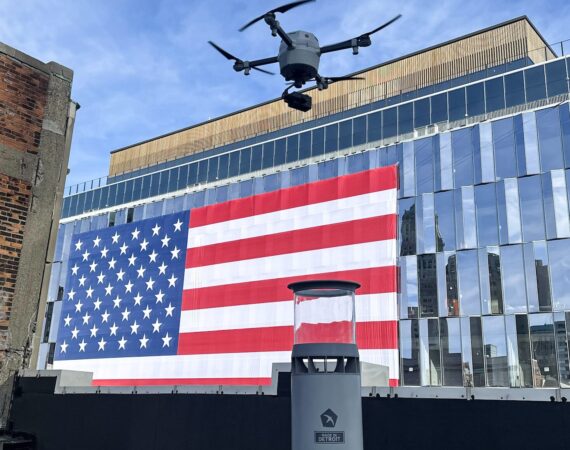
DRONE LAUNCH PAD AT MICHIGAN CENTRAL
That’s where Airspace Link enters the equation. Since 2018, the Detroit-based company has been working on digital infrastructure for safe and scalable drone operations: 3D maps layered with more than 60 real-time data sources, risk analysis, flight corridors, launch facilities, and — most importantly — a system to manage traffic in the air.
“When we talk about the future of infrastructure, we’re really talking about highways in the sky,” says Fahle. “We’re building the equivalent of stoplights, signage, speed limits — but digitally. Our UTM (Unmanned Traffic Management) system creates a hierarchy that allows multiple drones to fly safely. If public safety needs space for an emergency, or Amazon needs a corridor for delivery, there must be a way to reserve that airspace and ensure others move out of the way. That’s what makes safe scaling possible.”
How close are we to everyday drone use?
Closer than most people realize.
“It’s happening now,” says Fahle. “2026 will be a major leap — we’re seeing the regulations move forward and that will open the industry. A new framework will enable widespread autonomous drone operations, including beyond visual line of sight (BVLOS) flights for package delivery, agriculture, and civic interest, without individual waivers for certain activities.

YOUTH DRONE DAY AT MICHIGAN CENTRAL
There are also federal funding, large-scale pilots, and real deployment happening. “We’re seeing Amazon fly up to 250 flights per hour in places like Hazel Park and Pontiac,” he says. “Cities like Detroit are already purchasing systems to prepare.”
In Miao’s opinion, if it’s done right, drones will operate in the background of our lives, creating significant value.
“Our vision is that we’ll have millions of drones in the air — and you might not even notice,” he says. “Birdstop mainly focuses on rapid response currently — getting a bird’s-eye view to first responders during storms, crime, or emergencies. It’s another set of eyes in the sky. And if we do this right, they won’t get in anyone’s way.
Miao compares the evolution of drones to satellites: “We all use GPS every day. We rely on satellite data constantly — but we never think about the satellites themselves. Drones can function the same way. If this is built correctly, people will tune it out, even if there are millions of drones above us.”
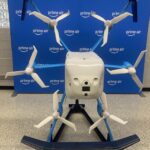
AMAZON DRONE
So, why Detroit?
Because the elements to create it – and the will – can all be found here.
“If you look back at history, Detroit has always taken on the hard tech,” says Whitaker. “The automobile was incredibly complex. Right now, drone technology has the same ability to reinvent mobility. And so much of the skill set already exists here — manufacturing, hardware, software, supply chains. It makes perfect sense for this region to step up. We’re not just flying drones here — we want to build them.”
That domestic manufacturing focus matters. As Miao notes, the U.S. currently produces less than one percent of the world’s drones — and the ones we do build cost more than some cars.
“It’s unnerving that America is struggling to manufacture this critical technology, especially as drones are literally saving lives,” says Miao. “Drones are increasingly a teammate in the sky for first responders and mission-critical teams. They are used hundreds of times a day now, and it’s just getting going. There are at least two million times a day that drones can get eyes on the scene before people are put into dangerous situations.”
As aerial mobility expands, so will the economic opportunity.
“We’re already seeing the need for pilots, airspace managers, maintenance techs, drone insurance, legal consultants — even launch operators,” says Fahle. “Workforce development is going to be huge. When EV infrastructure came online, entire industries grew around it. The same thing is about to happen with drones.”
What makes Michigan Central unique is the collaborative platform forming between startups, industry leaders, and regulators. Newlab is facilitating this — providing access to prototyping, real-world pilots, and shared infrastructure so companies can scale faster.
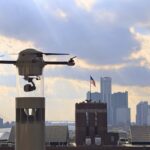
BIRDSTOP DRONE
“Once you create momentum, it becomes a gravitational center,” says Whitaker. “You create a space for partners to find each other. That’s what gets you to the next step. And because drones intersect with so many other mobility technologies — batteries, controllers, materials — Newlab is the perfect location.”
The future of aerial mobility is not an if — it’s a when.
“I think people will be surprised by how normal it all feels,” says Fahle. “Drone deliveries will become routine. Medical use will explode — because it’s faster, safer, and more efficient. And right behind that will be passenger use — people flying, not just packages. I think we’ll see that in three to five years.”
For Miao, five years is a lifetime in this industry. “Ten years is too far ahead to predict. But five years? I would love to see a million drones manufactured in Detroit every year. That’s ten times what the U.S. produces today — but it’s not crazy. Other countries already do it. Detroit can too.”
As always, be sure to subscribe to our newsletter for regular updates on all things Detroit and more.