



On Detroit’s west side, A Host of People is building theater that starts with a simple premise: stories matter — especially the ones that don’t always make it into the public record.
The multi-racial, experimental theater company creates original, multimedia work focused on social change. Every project is built from scratch, combining research, collaboration, design, and technology to explore the world we live in now — and the one we’re shaping for the future.
“We’re responding to what we’re experiencing,” says co-director Sherrine Azab. “What we’re feeling in our communities, and what we feel needs more representation.”
That process often begins with Azab and her co-director, Jake Hooker, bringing forward questions that feel urgent. More recently, longtime collaborators have begun leading projects themselves. One example is Good Ancestors, a multi-year thematic investigation that asks what it means to be a good ancestor — not just to the past, but to the generations that will follow us.

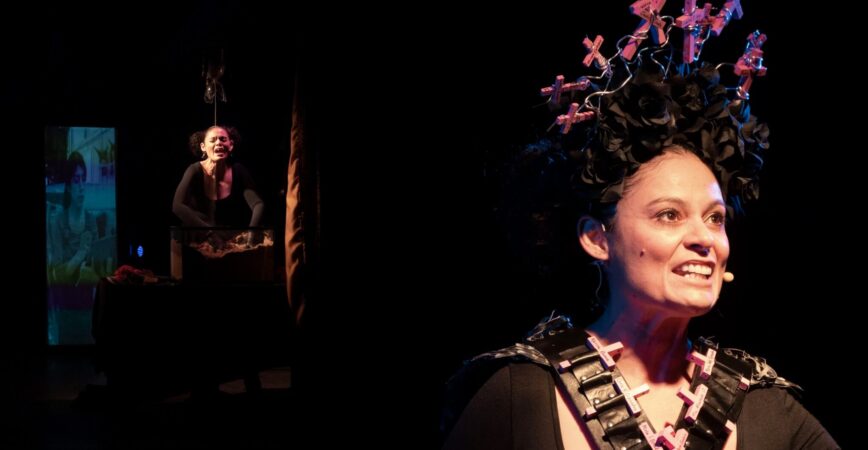
PAST PRODUCTION – CLEOPATRA BOY
The work spans formats, from tabletop theater and puppetry to video and live performance. But the goal is consistent: to use storytelling to examine how today’s decisions ripple across time.
History plays a central role in that work. A Host of People describes its practice as creating “lifelines” to history — a way of connecting past events to present realities and future possibilities.
“We’ve arrived where we are because of what’s already happened,” Azab says. “Our work looks to the past to talk about the present, and to help imagine a more just future.”
Each project begins with research and development. Ideas start small — what Azab calls “seedlings” — and are tested, reshaped, and refined over time. Working outside large institutions gives the company flexibility.
“We make our own timelines,” she says. “We decide which stories we tell. There’s no pressure to censor ourselves or avoid something that feels important.”
That independence also allows the company to adapt its structure. In its early years, A Host of People worked with a consistent ensemble of performers and designers. Over time, that shifted. Today, the company operates with a small year-round staff ensemble and an associate artist model, bringing in performers based on the needs of each project.
“The goal is to reach more collaborators and expand who gets to be part of the work,” Azab says.

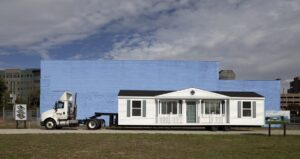
AHOP NEW BUILDING
Place matters, too. While the company has roots in Southwest Detroit, it is currently based on the west side, where it is preparing to move into a new building scheduled to open in 2027. Even before that move, the neighborhood shapes how the company thinks about its role.
“We want the work to be for everybody,” Azab says. “We’re not centering just one identity. We’re trying to create connections.”
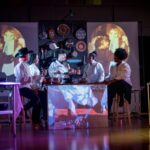
PAST PRODUCTION – NEITHER THERE, NOR HERE
That approach extends to audiences. Rather than making work only for traditional theatergoers, A Host of People aims for a mix: people who may see their own experiences reflected onstage, alongside people who don’t regularly participate in cultural spaces.
“In Detroit, there are a lot of people who don’t feel like the arts are for them,” Azab says. “We’re trying to change that.”
Access is a key part of that effort. Ticket prices have never exceeded $15, and no one is turned away for lack of funds.
“It’s not easy to operate this way,” Azab acknowledges. “But we care about getting the right people in the room. Professional theater doesn’t have to be expensive or exclusive.”
Community engagement goes beyond ticket prices. As the company prepares for its future home, Azab and her team have spent time getting to know neighbors — introducing themselves, maintaining the property, and being present.
“It’s about meeting people where they are,” she says.
Audience response has reinforced that approach. Rather than formal talkbacks, conversations often happen informally after performances.
“People tell us they’ve never seen themselves represented this way,” Azab says. “Or that they learned something they didn’t know before. Those conversations are what keep us going.”
Technology plays an important role in how those stories are told. Most productions incorporate video in some form, often designed by Cooker and integrated directly into the set or narrative. In Neither There Nor Here, which explored identities of in-betweenness, real family photographs were used to create a shared visual archive onstage.
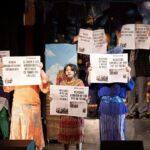
AHOP TEEN ENSEMBLE
“We use whatever tools the story needs,” Azab says. “Technology helps us tell stories in different ways, but it’s never the point on its own.”
That flexibility has led to meaningful partnerships. One project adapted a video game about housing justice, following a Black Detroit family navigating discriminatory systems across decades. Audience members made decisions in real time, turning abstract policy into lived experience.
Looking ahead, several projects are in development. A teen ensemble piece focused on Latine culture is underway. Shining Cities imagines sustainable futures through tabletop performance. Another project centers on dementia and memory loss, creating artistic spaces that feel accessible and safe for caregivers and those navigating isolation.
Across all of it, Azab returns to the same question: how do we move forward together?
“We’re in a moment where things feel very divided,” she says. “Our work is about making visible the connections between us — the lines that already exist, even when we don’t see them.”
As A Host of People grows — and prepares to occupy a space large enough to host other artists and filmmakers — its role in Detroit continues to expand. Not just as a theater company, but as a place for conversation, experimentation, and community.
A place to look back, understand where we are, and think more carefully about what comes next.
As always, be sure to subscribe to our newsletter for regular updates on all things Detroit and more.