

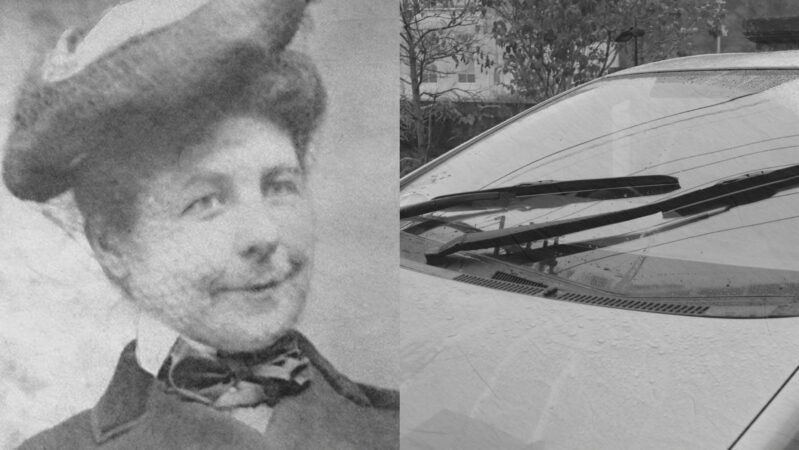



February is National Women Inventors Month, and in a city synonymous with automobiles, engineering, and innovation, it felt like the perfect moment to celebrate an invention we rely on nearly every day — yet rarely stop to think about.
It’s not an engine.
It’s not a transmission.
It’s not even the steering wheel.
It’s the windshield wiper.
Whether it’s a sudden Michigan snow squall, a freezing rainstorm, or a summer downpour, windshield wipers quietly make driving possible. And like many of the most practical innovations, the original idea didn’t come from a factory floor or R&D lab, it came from simple observation – by a woman.
The story begins in 1902, when Mary Anderson, a real estate developer from Alabama, took a trip to New York City. While riding a streetcar during a winter storm, Anderson noticed the driver repeatedly stopping to get out and wipe snow from the windshield by hand.
It was inefficient and unsafe, yet it was accepted as completely normal.
Anderson thought there had to be a better way.
The following year, she patented a device consisting of a swinging arm with a rubber blade that could be operated from inside the vehicle, allowing the driver to clear the windshield without stopping. In 1903, she was granted the first known patent for a windshield-cleaning device.
At the time, manufacturers weren’t interested. Some believed drivers would find the device distracting. Others didn’t yet see cars as everyday necessities. Anderson never made money from her invention, and her patent expired before the automobile industry truly took off.

Mary Anderson
But her idea stuck.
And eventually, it changed everything.
Early windshield wipers were manual, then motorized, and ultimately became standard equipment. But there was still one problem: timing.
Anyone who has ever driven through misty rain knows the frustration…full-speed wipers are too fast, turning them off is too slow, and constant manual adjustment is a nuisance.
Enter Detroit.
In the 1960s, Robert Kearns, an engineer living in Detroit, came up with a solution inspired by the human eye, which blinks intermittently rather than continuously. Working out of his basement, Kearns developed the intermittent windshield wiper, allowing drivers to control the delay between wipes.
The invention was revolutionary – and controversial.
Kearns’ technology was eventually used by major automakers without proper compensation. What followed was a long, high-profile legal battle that would span decades and become a landmark case in intellectual property law.
In the end, Kearns won, and intermittent wipers became standard equipment on cars around the world.
Together, Anderson’s original concept and Kearns’ refinement transformed the driving experience. What began as a simple mechanical arm evolved into rain-sensing systems, adaptive speeds, and integrated safety features — all tracing back to one woman noticing a problem on a snowy day.
It’s a reminder that innovation doesn’t always arrive with fanfare. Sometimes it arrives quietly, solves a practical problem, and becomes so embedded in daily life that we forget it was ever invented at all.
And fittingly, Detroit played a key role in taking that early idea and turning it into something scalable, reliable, and indispensable.
The next time your windshield wipers kick on automatically, sparing you a white-knuckle drive down Woodward or I-94, it’s worth remembering the unlikely path that made it possible.
A woman on a streetcar… a basement in Detroit … and an invention that made modern driving safer, smoother, and just a little bit easier.
As always, be sure to subscribe to our newsletter for regular updates on all things Detroit and more.