



When Backbone Hospitality owner Ping Ho, talks about Detroit’s food scene, she speaks from experience shaped by many roles: as a restaurateur, a builder, and a steadfast believer in the city’s potential.
As co-owner of Marrow West Village, Mink Detroit, and The Royce , and the driving force behind Marrow Detroit Provisions in Eastern Market, Ho has her hands in multiple corners of Detroit’s culinary ecosystem. Each of these ventures reflects her layered understanding of food, place, and business and together they reveal her nuanced take on where Detroit’s restaurants have been and where they’re heading.
“Detroit continues to evolve and grow,” Ho says.
Neighborhoods keep developing and thriving. There are many more options now – especially downtown – and that’s putting Detroit on the national map.
When asked how the city’s culinary landscape has changed over the past three years, her answer is rooted in both optimism and realism. She points to new operators and national players like Hudson’s and Union Square Hospitality Group as positive signals. But she’s quick to note that much of the growth still struggles with some of the same pressures the industry has faced since the pandemic.
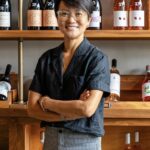
PING HO – PHOTOGRAPHY BY TAYLOR HIGGINS
“A lot of restaurants that have been around have survived, but the pressures from post-COVID still linger. Inflation, labor shortages and lack of density translate to challenges daily. Good, strong development is happening, but it’s happening in the context of constant operational challenges.”
The existence of both opportunity and constraint defines much of what it means to operate in Detroit today, especially for independent, local operators.
Ho’s latest large-scale effort – Marrow Detroit Provisions – reflects both her ambition and willingness to push boundaries.
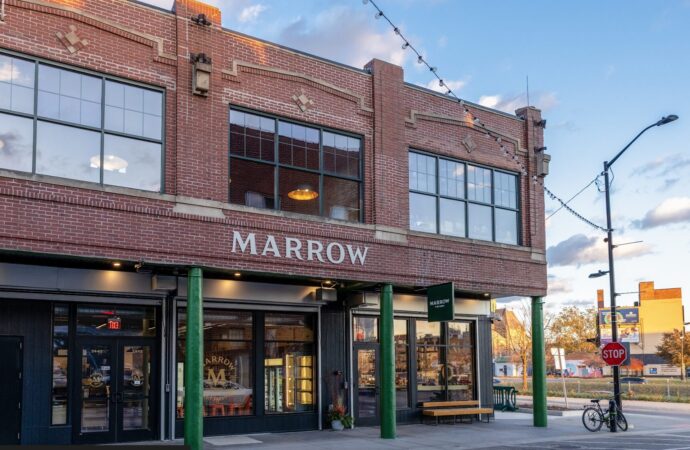
The project isn’t just another restaurant. Ho bought the Eastern Market building in late 2021 with the intention of creating something far larger and more layered. The space blends traditional hospitality with a butcher shop, a retail counter, lunch service, and a full-scale manufacturing facility.
“That was a huge learning experience,” she says. “We built our manufacturing operation alongside the restaurant, meat processing, production, everything under one roof. That’s a different business entirely. It goes beyond hospitality into true food production.”
After nearly three years, the production team has just moved in. The expanded facility, complete with new equipment that shortens processing times, opens doors for growth that were previously out of reach.
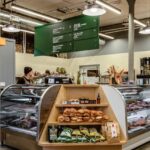
MARROW IN THE MARKET – PHOTOGRAPHY BY TAYLOR HIGGINS
“It’s ambitious,” she admits, “but I’m proud of how it turned out.”
What’s also notable about the Eastern Market location is the intentionality behind it. Ho selected this neighborhood because it’s not just historic, it’s emblematic of Detroit’s identity as a food hub. The largest historic, open-air farmer’s market district in the country, Eastern Market carries legacy, foot traffic, and community significance.
“As a restaurant group, we are one of the first full-service options there,” she explains. “It’s a destination. Weekends are huge. Weekdays can be slow, but that’s true of the market generally.”
Her hope, she says, is that more restaurants will see the potential in Eastern Market so that the area will become more of a destination daily.
Across her restaurants, Ho has learned that Detroit’s culinary growth is real, but it’s not without friction.
“One reality people outside the city often underestimate is population density,” she says. “There’s money and talent coming in, but we still need population growth. During the week, restaurants are competing for the same clientele. Until offices come back in full or more people live and work here downtown, that’s a constraint.”
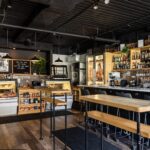
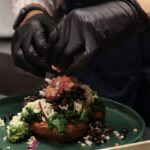
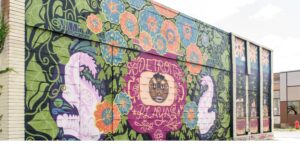
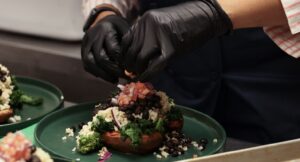
MARROW WEST VILLAGE – PHOTOGRAPHY BY TAYLOR HIGGINS
She sees this in neighborhood patterns: Marrow in West Village benefits from nearby residents and local foot traffic thanks to establishments like Shepherd and Little Village. Other districts, without that same density, face steeper challenges.
People flock when new places open, she says. That’s still true. But it won’t ultimately sustain a culinary ecosystem unless there’s a bigger population density supporting it.
Beyond operational challenges and new development, Ho has also been outspoken about the role of small businesses in broader civic conversations, most notably her response to ICE actions in late January.
“This topic is personal to me as an immigrant and non-U.S. citizen,” she says. “It touches a part of my life in a raw way. For many of us — citizens and non-citizens alike — what we’re seeing is scary.”
Ho framed her response not as political, but as community solidarity informed by lived experience.
“It was important to me to make our voice heard not just as an individual but as a business,” she said. “Independent owners have stepped up because we know the stakes. Corporate America isn’t necessarily doing so. We wanted to say: this is who we are and what we stand for.”
Her actions weren’t a full business shutdown, but a deliberate gesture of support and the response, she felt, resonated.
“Small, local businesses often play a role in holding communities together during uncertain times,” Ho says. “We’re rooted here. We employ people here. And we want to contribute to a narrative of support and solidarity.”
Even as Detroit’s national profile grows, Ho has a clear view of what should remain unchanged about its food culture.
“I hope we continue to see independent operators with diverse offerings,” she says.
I don’t want the food scene to become homogenized. Detroit still has room for diversity of price points and experiences as well – from higher-end to casual.
For Marrow, that includes continuing to champion quality meat offerings sourced locally. Ho is also expanding the Marrow brand into consumer packaged goods (CPG), placing nine SKUs in 60 grocery stores across Michigan, with further expansion on the horizon.
“It’s about bringing chef-driven quality to more people,” she says.
When asked what excites her most about the next chapter Ho is optimistic.
“I’m really excited for spring and summer,” she says. “For Marrow in Eastern Market, that means brunch, the patio, and seeing the market in full swing. That environment can be just fabulous.”
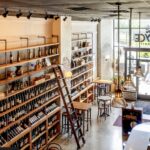
THE ROYCE
She also believes that Detroit’s culinary scene has reached a point where it can compete on a national stage, especially as more renowned operators like Danny Meyer enter the mix.
It will be interesting to see how Detroit evolves with these new influences, Ho says. I hope the local flair remains. And if we can bring in great talent across different concepts – that’s when Detroit truly becomes a food destination.
Ultimately, Ho’s vision is about building from a foundation of quality, integrity, and adaptability.
“It’s a tough industry,” she reflects. “Meat prices are high, supply is tight, labor isn’t getting cheaper – it’s intellectually challenging. But that’s also what makes it exciting. We’re constantly asking ourselves how we can do better.”
“Opening Marrow West Village felt like a beginning in 2018,” she adds. “And now here we are in 2026 with Marrow Provisions and it feels like another – much bigger – beginning to something great.”
As always, be sure to subscribe to our newsletter for regular updates on all things Detroit and more.