
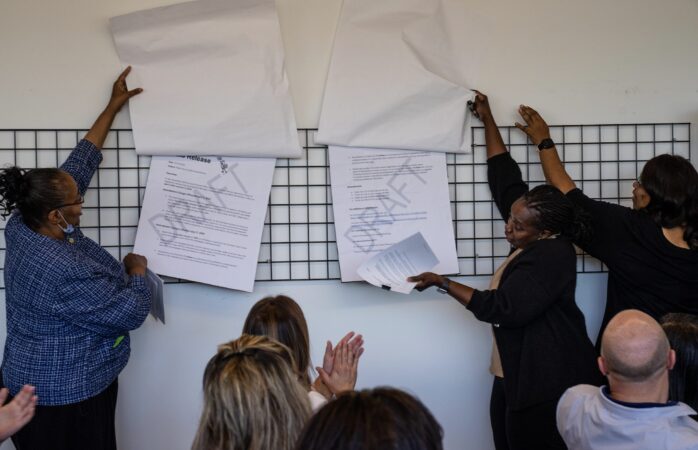



For more than a decade, Civilla has worked alongside public institutions to redesign how government services actually function for the people who rely on them. As the organization marks its 10-year anniversary, Detroitisit sat down with Civilla CEO Julia Dale to talk less about programs and more about the deeper questions facing Detroit right now.

JULIA DALE
DII: Civilla just marked its 10-year anniversary. Take us back to the beginning — what problem were you trying to solve when Civilla was founded?
Dale: Civilla grew out of a shared recognition that public institutions were not serving people the way they were intended to. Ten years ago, Michale Brennan, Lena and Adam Selzer met at Stanford’s design school. Mike had spent his career working inside long-standing public institutions, while Adam and Lena brought deep design expertise. What connected them was the realization that the systems people rely on – often in moments of real need – were fundamentally not working.
Civilla was born from the belief that change was possible. That if we could partner with public institutions and redesign services from the inside out, we could make them more humane, more effective, and more responsive to real human experience. At its core, Civilla has always been about hope — but not blind optimism. Hope paired with action.
DII: Detroit has a long history of grassroots organizing, distrust in institutions, and resilience. How does Civilla see its role within that broader civic ecosystem?
Dale: Detroit has been doing this work long before Civilla existed. People have been organizing, designing solutions, and holding institutions accountable for generations. We see ourselves as one contributor in a much larger ecosystem.
Our role is very specific: we work to change how public service institutions function so people don’t have to constantly find workarounds to survive broken systems. Ideally, when we do our work well, leaders can slow down, acknowledge what isn’t working, and redesign around lived experience instead of assumptions.
DII: From your perspective, what’s most broken about how public institutions function today — and what gives you hope they can be redesigned?
Dale: I spent more than 24 years in state government before coming to Civilla, and I often felt this deep sense that things simply weren’t working. Even when problems were clearly identified, the approaches used to fix them weren’t leading to better outcomes.
Too often, institutions focus on the problem as they define it, rather than the person navigating the system. We call this focusing on the “person on the path.” When leaders are willing to admit they don’t have all the answers – and have the courage to ask different questions – that’s where hope begins.
But hope alone isn’t enough. Optimism has to be a practice. It means testing, learning, and making progress, even when it’s uncomfortable. At Civilla, one of our core commitments is making optimism credible.
CIVILLA LEADERSHIP TEAM
DII: How do you translate systems thinking into tangible outcomes for residents, especially in communities historically excluded from decision-making?
Dale: We start by listening deeply. We sit at kitchen tables and in living rooms. We talk directly with people navigating these systems every day. That changes everything.
When you lift up lived experience, you see the real problem, not the version institutions assume exists. From there, we engage people directly in designing solutions. That co-creation is what makes change tangible and durable.
DII: Many cities look to Detroit as a model for reinvention. What lessons from Detroit’s civic landscape feel most relevant to other cities right now?
Dale: One big lesson is that resilience alone is not a strategy. Detroiters are incredibly resourceful, but the goal shouldn’t be to make people better at surviving broken systems. The goal should be to fix the systems.
Another lesson is that trust can’t be rebuilt through messaging. It’s rebuilt through experience. When people interact with systems that actually work for them – especially in moments of crisis – trust begins to return.
And finally, change takes time. Staying power matters. Durable reform requires leaders who are willing to stay, even when it gets uncomfortable, and to own past mistakes.
DII: How does Civilla think about success when the work is long-term and not easily captured by short-term metrics?
Dale: We’ve always taken a long view. Some of our partnerships, like those with the Michigan Department of Health and Human Services, have spanned a decade and involved a multitude of projects. That longevity builds momentum and institutional understanding.
Success means changes that outlive us – processes and mindsets that remain after Civilla steps away. It’s when leaders develop high expectations for human-centered design and center people, not just KPIs, in their decision-making.
DII: Looking ahead, what role do organizations like Civilla play as cities face overlapping challenges, from inequality and climate pressure to declining public trust?
Dale: There’s a tremendous opportunity right now. Organizations like Civilla can help institutions become more resilient, more humane, and more trustworthy, especially during times of crisis.
When leaders prioritize individual experience and design systems accordingly, they unlock enormous potential. Trust follows function. And in moments of unrest or transition, optimism isn’t optional, it’s essential.
DII: As Detroit enters a new political chapter, what feels most important to hold onto right now?
Courage and optimism. Especially now.
It takes courage to say, “What we’ve been doing isn’t working.” And it takes optimism to believe we can build something better. Detroit has always been a city of reinvention. The opportunity now is to make that reinvention truly serve the people who call it home.
As always, be sure to subscribe to our newsletter for regular updates on all things Detroit and more.