
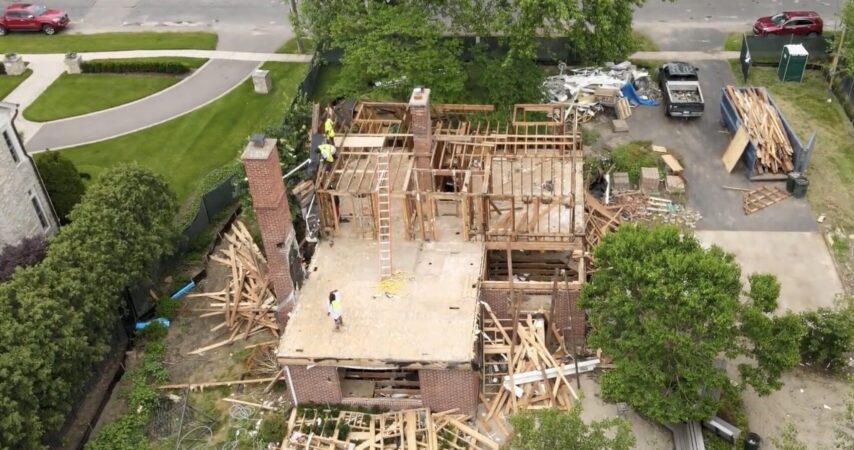



In a city shaped by cycles of construction, abandonment, and reinvention, demolition has long been treated as an end point. Tear it down. Haul it away. Move on. But at the Architectural Salvage Warehouse of Detroit, the work begins where most projects stop — not with destruction, but with careful removal and reuse.
Founded in 2003 and led since 2013 by Executive Director Chris Rutherford, the organization has built a rare and quietly effective model centered on one simple idea: valuable materials shouldn’t be wasted just because a building’s life has ended.

ASW DETROIT
DECONSTRUCTION
Instead of knocking houses down, ASW Detroit deconstructs them — piece by piece — salvaging lumber, doors, trim, fixtures, and architectural elements and putting them back into circulation.
“When we deconstruct a home, 80 to 90 percent of the material is saved from the landfill,” Rutherford says. “That’s a full semi-trailer of lumber from a single house.”
What happens to those materials next is where ASW’s work becomes more than salvage.
Unlike many mission-driven organizations, ASW Detroit operates largely as a fee-for-service business. Property owners pay the organization to deconstruct homes, and that revenue supports a multi-pronged operation that includes retail sales, construction and millwork, wholesale material distribution, and workforce development. The diversification isn’t accidental — it’s what allows the organization to weather economic swings and continue operating without heavy reliance on grant funding.
Today, ASW Detroit’s work spans several interconnected areas. Its retail store, now housed in a building the organization purchased last year near the Packard Plant, sells salvaged materials at low cost to homeowners, builders, architects, and designers.
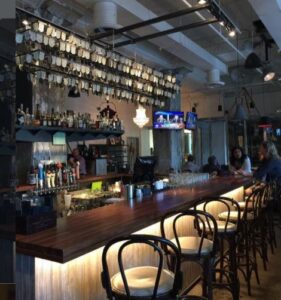
Its construction arm works with architects and property owners to design and build new spaces using reclaimed materials, including visible projects like millwork at the Foundation Hotel and the Apparatus Room. A full mill shop allows ASW to turn salvaged lumber into furniture, architectural elements, and custom builds.
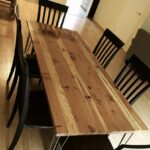
2X4 PLANK TABLE
The organization also operates a wholesale business, shipping flatbed trailers of reclaimed lumber to clients across the Midwest when supply allows. One recent example is the Gordie Howe International Bridge project, where scaffolding lumber was reclaimed, reused locally, and also shipped to clients in Wisconsin.
“We’re trying to grow a full reuse marketplace,” Rutherford says. “The more outlets we have for these materials, the more deconstruction we can do. And every time we don’t do it, those materials end up in a landfill.”

VINTAGE CAST IRON FIRE ALARM
That commitment to keeping materials in circulation extends beyond buildings. ASW Detroit is also deeply involved in urban wood reuse, salvaging trees removed for development or city maintenance and turning them into usable lumber. Red oak and silver maple — trees that once lined Detroit’s streets — are now finding new life as furniture, flooring, and architectural features.
In recent years, the organization has also become a quiet incubator for Detroit makers. Workshop Detroit, Wallace Detroit Guitars, and Detroit Audio Lab have all worked with ASW materials to create guitars, speakers, and other products, proving that reuse can support not just sustainability goals, but local manufacturing and creative enterprise.
But perhaps the most impactful evolution of ASW’s mission has come through its Community Uplift Program. Historically focused on providing low-cost materials, the organization expanded its mission in fall 2024 to offer no-cost building materials to Detroit residents living near the poverty line. Lumber, doors, windows, appliances, lighting and more are now being granted directly to families who need them.
“Our mission has always been to provide affordable materials,” Rutherford says. “This is about going one step further — empowering people to make their homes safer and healthier.”
The program also solves a practical challenge. Moving materials quickly allows ASW to bring more in, keeping its operations flowing while serving residents at the same time. “It’s a win-win,” Rutherford says.
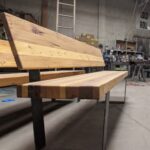
RECONSTRUCTED WOOD BENCH
ASW Detroit’s work also reflects a broader cultural role in the city — preserving history by letting materials move forward. While not every building can be saved, Rutherford believes these materials can carry a story into the future.
“If we can’t save a structure, we can still save the wood,” he says. “That oak might become a dining table, or a guitar, or part of a new building. The materials we’ve kept out of landfills can be seen throughout the city.”
This played out in a highly visible way last year, when ASW Detroit partnered with DTE Energy and the City of Detroit to deconstruct the city’s official Christmas tree.
Instead of discarding it, the massive tree was taken apart, slabbed into lumber, and reused for projects around the city — a symbolic and practical example of reuse embedded in Detroit’s public life.
It’s also a reminder that ASW’s work sits at the intersection of environmental stewardship, economic resilience, and workforce development. The organization employs returning citizens and individuals facing barriers to employment, offering work tied directly to community impact.
“Reuse creates jobs,” Rutherford says. “And it gives people skills they can carry with them.”
Looking ahead, Rutherford hopes Detroit continues shifting from crisis response toward intentional, sustainable systems. After nearly three decades in the city, he sees progress not just in growth, but in how that growth is happening.

THE APPARATUS ROOM
“We’ve come to a point in Detroit where we are passed the triage phase where we were working to simply get blight out quickly. Now we can slow down, do things right, put people to work, preserve our history, and keep materials out of landfills.”
At a time when cities everywhere are grappling with waste, housing affordability, and climate pressure, the Architectural Salvage Warehouse of Detroit offers a grounded alternative — one built not on sweeping gestures, but on careful hands, practical systems, and the belief that what already exists still has value.
“We can make a deep impact on Detroit while showing other cities what this looks like,” Rutherford says.
As always, be sure to subscribe to our newsletter for regular updates on all things Detroit and more
















What a fantastic business model to salvage and reuse materials. Kudos to Architectural Salvage Warehouse of Detroit! All businesses should operate in a circular fashion–designing out waste, pollution and greenhouse gases. I just learned of an innovative program NEXTCYCLE MICHIGAN which connects circular entrepreneurs to resources and support to help them grow and scale their companies so they can bring innovative solutions to reducing waste to Michigan: https://nextcyclemichigan.com/