



In December, the Hudson-Webber Foundation announced $900,000 in new grants supporting affordable housing, community safety, and policy organizations working across Detroit and Michigan. The funding went to groups including the Detroit Economic Growth Association, Detroit Public Safety Foundation, Citizens Research Council, The Center for Michigan, and the Michigan League for Public Policy.
It was a significant investment, but for Hudson-Webber President and CEO Donald Rencher, the announcement represents something more complicated than a single funding moment. It reflects how the foundation thinks about Detroit right now: a city with momentum, real challenges, and an urgent need to make sure systems are working for the people who live here.
“Detroit is in a moment of transition,” Rencher says. “Leadership is changing, the economy is shifting, and people are paying close attention to where the city is headed — and who that future is really for.”
Rencher points first to the broader context. After more than a decade under the same mayor, Detroit is entering a new chapter with Mary Sheffield, a black woman born and raised in Detroit who he says, “is substantially connected to the city.”

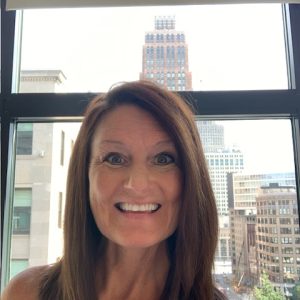
CEO DONALD RENCHER
That change, along with his faith in the public and private sector working together, has him feeling inspired and optimistic regarding the future vision and direction.
Conversely, with rising housing costs, uncertainty around immigration laws, and changing national economic policy, there are many things the foundation is keeping its eyes closely on.
“At the same time,” he says, “Detroit remains the center of gravity for Michigan and Southeast Michigan. The investment is still coming. The belief in the city is still there.”
Detroit’s “comeback” has become a familiar story – one Rencher says contains truth but also leaves out critical nuances.
“There’s no question that Detroit has received a lot of attention and investment, and that’s a good thing,” he says.
But we also have to acknowledge that a large percentage of residents are still living in poverty. For many people, the benefits of that investment don’t feel tangible yet.
That disconnect between progress on paper and lived experience is something Hudson-Webber is also watching closely. Rencher notes that data can show improvements, such as reductions in violent crime and billions invested in affordable housing, but residents may still feel unsafe or squeezed by rising costs.
“Perception matters,” he says. “If the data says one thing but people don’t feel it in their daily lives, that gap is important.”
Hudson-Webber’s Neighborhood Vitality Index, which looks at how residents experience their neighborhoods, is one way the foundation tries to understand that gap more clearly. It’s also a reminder that progress isn’t only measured in metrics, it’s measured in whether people feel stable, safe, and able to stay in their communities.
Rencher is honest about the challenges that have proven hardest to solve, even as investment has increased.
“Poverty remains the most persistent issue,” he says. “I moved into Detroit in 2012, and many of the same conversations about poverty are still happening today.”
There’s no single solution, he says. Addressing poverty requires work across housing, education, workforce development, transportation, and policy, often simultaneously. And even then, progress is incremental.
“That’s why systems-level work matters,” Rencher says. “If we don’t change how systems function, we end up treating symptoms instead of causes.”
That philosophy shapes Hudson-Webber’s approach to funding.
Hudson-Webber is not the largest foundation in Detroit, Rencher is quick to acknowledge. But even if it were, philanthropic dollars would still pale in comparison to public funding and private investment.
“Our role isn’t to replace government or the corporate sector,” he says. “It’s to act as a catalyst and support the people and policies that can create lasting change.”
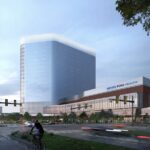
HENRY FORD HEALTH BUILDING
That’s why the foundation often invests in policy work, coordination efforts, and infrastructure that can unlock larger gains. Recent grants supporting housing coordination, public safety infrastructure, and policy research fall squarely into that category.
Rencher points to past collaborations with the city on housing policy as an example. While less visible than direct services, those efforts can reshape how resources flow for years to come.
“This work takes time,” he says. “But when it works, it changes the landscape.”
Detroit benefits from a strong philanthropic ecosystem, Rencher says, one filled with organizations deeply committed to the city. One of philanthropy’s greatest strengths, he believes, is its ability to convene.
“Philanthropy can bring people together – government, nonprofits, business – and help align strategies,” he says. “That convening power is huge.”
At the same time, he’s clear about where philanthropy should step back.
“We have to lead with community voice,” Rencher says. “If we’re not grounded in what residents are actually asking for, then we’re missing the point.”
He also believes there’s room for greater alignment across foundations, not in identity or mission, but in shared priorities.
“We’re better together than we are operating in silos,” he says. “The more aligned we are around strategies, the more impact we can have.”
Despite the challenges, Rencher remains cautiously optimistic about Detroit’s future – largely because of Detroit residents.
“People who live here believe in this city,” he says. “That belief is one of our greatest assets.”
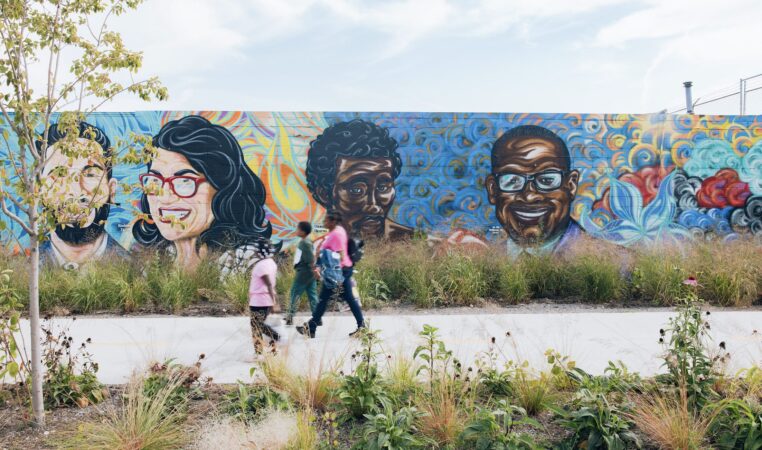
He points to important investments, such as the Joe Louis Greenway, riverfront improvements, the new Henry Ford Hospital, the new University of Michigan Center for Innovation, as signals of long-term commitment. But he’s careful not to frame them as solutions on their own.
“All of that investment matters,” he says. “But it has to translate into affordability, opportunity, and quality of life.”
That brings the conversation back to fundamentals: housing costs, property taxes, access to good jobs, and the ability for families to stay rooted in their neighborhoods.
“If Detroit can remain a place that’s not just exciting to visit, but affordable to live in, that’s where real progress happens,” Rencher says.
For people who care deeply about Detroit but feel overwhelmed by the scale of its challenges, Rencher offers a grounded perspective. “Big change doesn’t happen overnight,” he says. “We’ve made real progress over the last 12 years, even if it doesn’t always feel fast enough.”
Detroit’s recovery from bankruptcy, he notes, was once unimaginable. Today, the city is building again – economically, socially, and civically. “We shouldn’t deny how far we’ve come,” he says. “At the same time, we have to stay honest about how much work remains.”
For Hudson-Webber, that means continuing to invest in systems, policies, and people – even when the outcomes aren’t immediate.
“There’s still more to do,” Rencher says. “But I believe we can do it. That belief, shared by residents, organizations, and leaders, is what gives me confidence in Detroit’s future.”
As always, be sure to subscribe to our newsletter for regular updates on all things Detroit and more.