



In Detroit, there is roughly one primary care physician for every 6,000 residents. Just 20 miles north in Oakland County, that ratio is closer to one for every 600.
For Dr. Paul Thomas, founder of Plum Health Direct Primary Care, that disparity is not ok.
“When doctors are paid more to take patients with private insurance, practices and hospital systems tend to cluster in wealthier communities,” Thomas explains. “That leaves places like the city of Detroit medically underserved.”
Thomas launched Plum Health in 2016 under a Direct Primary Care (DPC) model – years before the approach entered broader healthcare reform conversations. His mission was simple: make primary care affordable, accessible and relationship-driven in a city where access has long been uneven.
“I wanted to deliver excellent care at a price people could afford,” he says. “And I knew I couldn’t do that within a traditional insurance-based model.”
Traditional primary care in the U.S. operates largely on a fee-for-service system. Doctors are reimbursed per visit, per procedure, per interaction. To remain financially viable, physicians often carry patient panels of 2,000 or more, scheduling 20 to 24 visits per day – sometimes double or triple booking to keep up with demand.
“You’re seeing patients for 10 or 15 minutes,” Thomas says. “Then you’re charting at night for 90 minutes or more. The only way you get paid is face-to-face. There’s no room for urgent needs. Schedulers don’t want empty slots.”

DR PAUL THOMAS
In Detroit, where healthcare access is already strained, that structure compounds inequity.
Under the DPC model, insurance is removed from routine primary care. Instead, patients pay a flat monthly membership fee – at Plum Health, $85 per month for adults – which covers most primary care services, longer appointments and direct access to their physician.
Thomas caps his patient panel at roughly 500 people. On a typical day, he sees five to eight patients.
“When we see about one percent of our panel per day, that’s five to eight visits,” he explains. “We spend up to five hours seeing patients and still have time for administrative work and urgent needs. We reduce the panel by a factor of five and give five times more time to each patient.”
The shift is operational, but it is also relational.
“When you remove insurance from the equation, you restore a genuine relationship with the doctor,” Thomas says. “Patients can call, text or email. We guarantee same-day or next-day appointments. The average wait time nationally is 28 days. That doesn’t work for people.”
Initial visits at Plum Health last about an hour. Follow-ups are typically 30 minutes. That time allows for deeper conversations about medications, specialist coordination and daily habits that shape long-term health outcomes.
Plum Health’s membership base reflects the city’s economic diversity.
Thomas describes three primary groups.
First are uninsured individuals such as bartenders, waitstaff, freelancers and others whose income places them outside Medicaid eligibility but who may not have employer-sponsored coverage.
Second are the underinsured – people with high-deductible plans, sometimes $8,000 or even $16,000 family deductibles. For them, a DPC membership can prevent costly urgent care or emergency room visits, keeping routine care outside the insurance deductible structure.
“The service often pays for itself,” Thomas says. “If we prevent an urgent care visit or manage medications proactively, patients avoid hitting that deductible.”
The third group includes professionals with robust insurance plans but limited time.
“For some people, time is their most valuable resource,” Thomas says. “They have coverage through Blue Cross or another carrier, but they can’t text their doctor. They can’t get in quickly. We make healthcare convenient and accessible.”
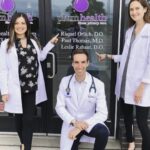
DR. RAQUEL ORLICH, DR. PAUL THOMAS AND DR. LESLIE RABAUT
Plum Health also works with employer groups, an increasingly significant part of its growth.
Healthcare costs for businesses have risen sharply in recent years, with annual increases sometimes reaching 10, 20 or even 30 percent. In response, many forward-thinking companies are shifting to self-funded plans and layering in DPC services to manage costs.
“When employers engage with us, we see about a 75 percent reduction in urgent care utilization,” Thomas says. “Every urgent care visit avoided saves around $350. We also see roughly a 40 percent reduction in emergency room use. Preventing one ER visit can save about $2,000.”
On average, Plum Health estimates savings of approximately $1,700 per engaged employee per year.
“Twenty to thirty percent of Americans don’t have a primary care doctor,” Thomas adds. “So they default to urgent care or the emergency room. That’s expensive for everyone – the individual, the employer and the system. When you have a known doctor you can reach quickly, you use resources more judiciously.”
In practical terms, that might mean texting a photo of a cut finger to determine whether it can be treated in-office rather than defaulting to the ER.
“They shouldn’t get in the way of someone having a heart attack,” Thomas says. “That’s what emergency rooms are for.”
When Thomas launched Plum Health in 2016, only about 300 physicians nationwide practiced under a DPC model. Today, that number is estimated at 3,000 to 3,500.
Still, the broader primary care workforce in the U.S. includes well over 100,000 family medicine physicians.
Thomas believes the future may follow an 80/20 distribution.
“Probably 80 percent of doctors will remain in traditional insurance-based models,” he says. “But maybe 20 percent want more autonomy, more time with patients and better relationships. That’s where DPC fits.”
He is careful not to frame the model as a universal replacement. Concierge medicine, for example, serves a different niche, often charging $2,500 or more annually while still billing insurance and maintaining smaller patient panels of 200 to 300.
“Concierge medicine has its place,” Thomas says. “Direct Primary Care is designed to be accessible at a lower price point.”
Internationally, he notes, countries that invest more heavily in primary care tend to see better overall health outcomes and longer healthspans.
“The U.S. does not invest enough in primary care,” he says. “DPC is a way of right-sizing that investment at the individual or employer level.”
In Detroit, where healthcare access gaps remain pronounced, that recalibration carries particular weight.
“I’m doing my part to be the change I want to see in the system,” Thomas says.
As always, be sure to subscribe to our newsletter for regular updates on all things Detroit and more.