

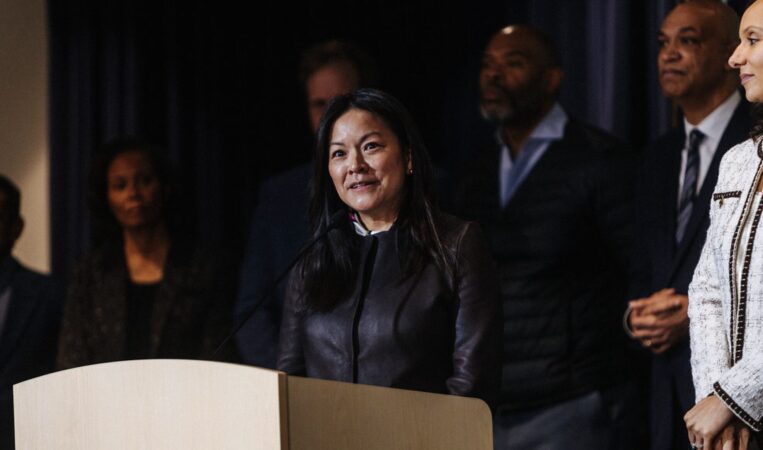



Most people don’t think about how a city works until something doesn’t. A delayed bus, a permit that takes weeks longer than expected, a phone call that leads nowhere – these are small moments, but they add up quickly. And they are exactly where Winnie Liao is focused.
Thirty days into her role as Chief Operating Officer for the City of Detroit, Liao is not talking about sweeping changes or big announcements. Instead, she keeps returning to something more fundamental: how systems work, and whether they actually work for people.
Liao’s path to municipal government is not a traditional one. Her career spans startups, healthcare, technology, real estate and consulting, with experience advising large organizations and working inside complex systems. She describes it as “chapters in a book,” each one building toward the next. What connects them is a consistent interest in how large, often rigid systems can be reshaped to better serve the community.
“I’ve always been fascinated by complex systems,” she says. “How do we make these systems work for people?”
That question has followed her through both private and public sector roles, including her work with Mastercard and the Michigan Secretary of State. It also led her, eventually, back to Detroit – a city she grew up near and felt drawn to return to in a more meaningful way.
Part of what makes this role feel like a natural next step, she says, is the scale of impact. In the private sector, change can often be incremental. In government, the stakes and the reach are different.
“When you think about municipal government, it’s one of the most challenging environments,” she says. “But it’s also one of the most rewarding, because you can create change at scale.”
There is also, in her view, a different level of responsibility. Residents, she points out, don’t have a choice in the way they do as consumers.
“In the private sector, if you don’t like a product or service, you can go somewhere else,” she says. “In government, that’s not the case. We are the only provider of these services, which means we have to hold ourselves to a higher standard.”
That standard, for Liao, comes down to something simple but often overlooked: respect for people’s time.
She recalls an early experience visiting Secretary of State branch offices, where she spent time observing how people moved through the system. She noticed a mother sitting on the floor with her children after taking time off work and traveling by public transit, only to face a long wait.
“How is that acceptable?” she says. “It was such a clear example of how we were not respecting people’s time.”
That moment has stayed with her. It’s also shaped how she approaches her work today.
As humans, the only common currency we all have is time. Every minute someone spends navigating a website, waiting on the phone, or trying to find the right information, there’s a real cost.
From her perspective, improving government services isn’t about adding more technology or more layers. In fact, she cautions against that instinct.
“There’s often this assumption that technology will solve everything,” she says. “But it’s not about the tech. It’s about trust, predictability, and reliability.”
In practice, that means stepping back and rethinking how systems are designed in the first place. One of the first things she looks for is friction—where processes break down, where people get stuck, where multiple departments operate in isolation.
Detroit, like many large cities, is made up of multiple departments, each with its own processes. For Liao, part of the work is identifying how those systems disconnect and where there’s an opportunity to simplify.
“Right now, if you want to open a business or build something, you might have to go through multiple departments and multiple permitting systems,” she says. “That creates unnecessary complexity.”
Her goal is to move toward a more unified experience – what she describes as a “one-stop” approach where people don’t have to navigate the system on their own or rely on expensive consultants just to understand the process.
“It should feel like the city is an enabler and a partner, not a roadblock,” she says.
That kind of shift requires more than surface-level changes. It involves rethinking how departments work together, breaking down silos, and aligning teams around shared goals.
“If everyone is rowing in different directions, you’re not going to get anywhere,” she says. “We have to be aligned on priorities and working together.”
Part of her role, especially coming out of Mayor Mary Sheffield’s recent State of the City address, is to translate vision into execution. Where the mayor sets direction, Liao sees her responsibility as building the systems and processes that make those goals tangible.
My job is to take the ‘what’ and turn it into the ‘how’,
she says.
That might mean looking at something like public transit and asking a straightforward question: does the bus show up on time? Or examining how small business owners interact with the city and identifying where delays or confusion might be costing them time and money.
It also means using data differently – not just to measure performance, but to understand why something isn’t working.
“It’s not enough to know that something is late or not performing,” she says. “You have to understand the root cause and then act on it.”
Even with that focus, Liao is careful about how she approaches change. Rather than coming in and immediately overhauling systems, she emphasizes listening first, especially to the people doing the work every day.
“The frontline staff are often the ones who already know where the problems are and how to fix them,” she says. “You have to start there.”
From there, she sees her role as both a challenger and a support system: asking difficult questions, removing barriers, and helping teams move forward.
“Transformation isn’t comfortable,” she says. “It requires people to think differently and work differently. My job is to help create that environment and give people the tools to succeed.”
At the same time, she’s mindful that change doesn’t happen all at once. Early momentum, she says, often comes from identifying low-hanging fruit – improvements that can be made quickly and help build confidence.
Over time, the goal is something more lasting: systems that function smoothly, consistently, and without drawing attention to themselves.
“I think the best version of this work is when you don’t see it,” she says. “It just works.”
That idea of an “invisible” system that supports daily life without friction is what ultimately drives her approach. It’s also how she measures success.
“If I’ve done my job well, you won’t necessarily even know my name,” she says. “But you’ll feel it in how the city works.”
For Liao, that’s the point. Not recognition, but reliability. Not a single initiative, but a shift in how the system functions as a whole.
And in a city where so much depends on how systems function day to day, that kind of work has the potential to shape not just individual experiences, but the way people feel about Detroit itself.
As always, be sure to subscribe to our newsletter for regular updates on all things Detroit and more.