



There’s a growing conversation happening around how cities move – not just people, but goods.
In Detroit, that conversation is starting to take shape in a tangible way.
One of the companies at the center of it is Civilized Cycles. Founded by Marc Liu and Zachary Schieffelin, the company was recently named one of the winners of the Toyota Mobility Foundation Sustainable Cities Challenge. The global competition, which focused on clean freight solutions in the city’s Eastern Market, is designed to move ideas out of theory and into real-world application.
For Civilized Cycles, that’s exactly where they want to be.
“It’s huge for us,” says co-founder Mark Liu. “To have support from Toyota – a company that defines the global transportation industry – and to be able to scale and prove this out in Detroit, it’s really a transformational moment for us.”
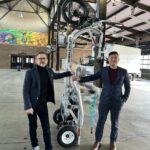
ZACHARY AND MARC
The company’s focus is specific. Civilized Cycles builds light electric cargo vehicles designed for short-distance transportation, the one- to five-mile trips that happen constantly within cities but are often handled by oversized vans and trucks.
“A lot of the work so far around Electric Vehicles has focused on long-distance or passenger transportation,” Liu says. “But there’s a huge amount of movement happening in that short-range space, and there aren’t many solutions built for it.”
Today, those trips are typically handled by vehicles that are expensive to operate, difficult to maneuver in dense areas, contribute to congestion and emissions, and can even be dangerous to pedestrians. For many small businesses, the cost alone can be limiting.
“A new truck can cost $50,000, and that’s before you factor in insurance, maintenance, fuel, parking,” Liu says. “There are businesses that simply can’t afford to operate that way so it becomes a barrier to entry.”
Civilized Cycles is offering an alternative, one that is smaller, electric and designed specifically for urban environments.
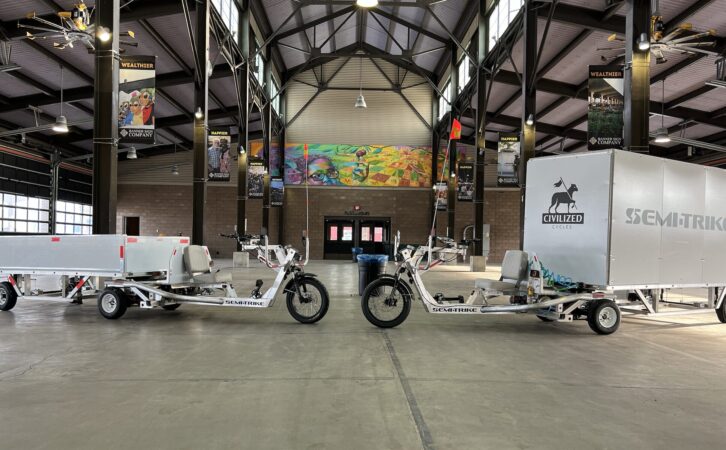
Their first product was an electric bike, but Liu is quick to point out its limitations – it’s designed to move a single person from place to place. The broader vision is much more expansive: a patented Semi-Trike built to carry cargo efficiently while reducing the footprint, cost and complexity of traditional delivery vehicles.
But Liu says the goal extends beyond the vehicle itself.
“The bigger picture is getting trucks and vans off city streets where they don’t need to be,” Liu says. “At the top level, the priority is moving away from fossil fuel as quickly as possible. But beyond that, they impact how a city functions – from safety to noise to overall quality of life.”
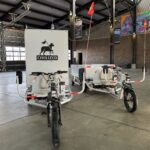
SEMI-TRIKE
Detroit, he says, is the right place to test that idea, largely because of how the city is structured.
“What makes Detroit interesting is that it’s similar to a lot of other cities,” Liu says. “You have a dense urban core, but you also have surrounding suburban areas not unlike Columbus, Chicago or Minneapolis. If something works here, there’s a good chance it can translate elsewhere.”
He also points to the Midwestern infrastructure from road conditions to weather, which creates a more demanding environment for new technology. Proving a concept in Detroit means proving it under real-world conditions.
“It’s not a controlled environment,” Liu says. “You’re dealing with everything from rough roads to changing weather. That’s important.”
Through the Sustainable Cities Challenge, Civilized Cycles will now have the opportunity to test its technology at a larger scale.
Over the next year, the company plans to deploy four to six of its vehicles in and around Eastern Market, working with logistics partners, local organizations and businesses to better understand how the model performs day to day.
Liu says, “We will be rigorously testing the technology. What does it look like when a small fleet is operating consistently in a space? Where does it add the most value? Where can we improve?”
For businesses, the impact could be immediate, particularly when it comes to cost and access.
Beyond affordability, the vehicles expand who can participate in the workforce. Because they fall into a bicycle-class category, they do not require a license to operate, opening the door to a wider range of workers.
“That’s a meaningful shift,” Liu says. “It creates more opportunity for people to be part of the system.”
As cities continue to rethink how they move people – through bike lanes, shared mobility and expanded transit – there is increasing recognition that goods need to be part of that equation as well.
“You can’t redesign a city for passenger movement and ignore how goods are delivered,” Liu says. “One follows the other.”
In North America, that shift is still in its early stages.
“We’re at the beginning of what’s possible in urban freight,” Liu says. “We are one of many players changing the way we move goods and there is so much to learn. We fully expect some major evolutions over the coming years and are excited to see what that looks like.”
As always, be sure to subscribe to our newsletter for regular updates on all things Detroit and more.