
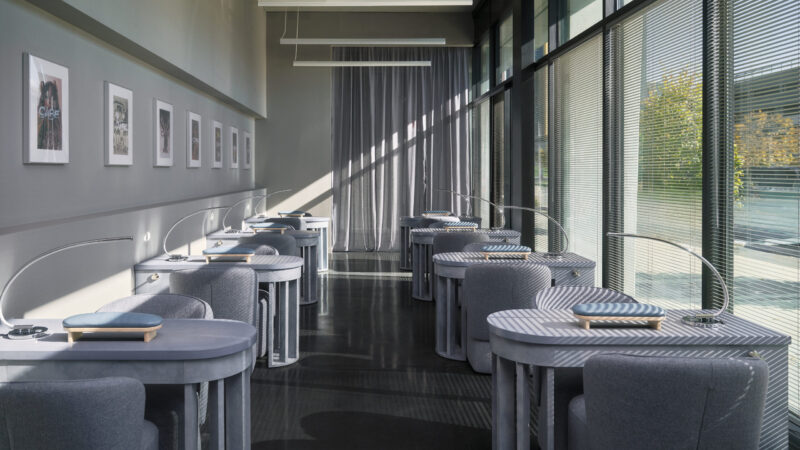



Cure Nailhouse isn’t a nail salon in the traditional sense. It’s a space shaped by culture, ancestry, art, and beauty.
“I won’t call it a service, I call it an artistic practice,” says founder Cyndia Robinson.
Cure has been open for just over eight months, but the work behind it goes much further back, developed through a combination of experience, personal beliefs, and formal study. Before opening the space, Robinson built a career across marketing, communications, nonprofit work, and tech – experiences that help form how she thinks about Cure Nailhouse not just as a business, but as a platform for storytelling, art, and impact.
“I’ve always been interested in storytelling,” she says. “That’s really how I frame everything.”

CYNDIA ROBINSON
After moving back downtown from metro Detroit, Robinson enrolled at Wayne State University to pursue a master’s degree in public administration and nonprofit management. Throughout her studies, Cure became something she returned to again and again as something to be tested, refined, and challenged in real time.
“My professors let me focus many of my assignments around Cure program building, structure, and vision,” she says. “I received so much valuable feedback and critique in shaping it.”
By the time she graduated, that process had become something concrete. Her thesis evolved into the business plan, and not long after, she had the keys to the space.
But the work itself was never new. Robinson has been practicing nails in some form for most of her life.
“I’ve started getting my nails done in my mom’s lap since I was four,” she says. “It’s ingrained in my culture.”
Her mother eventually transformed their basement into a full nail salon when she was around ten years old, turning what began as curiosity into something much more formative. Those early experiences shaped how she understood beauty – not as something superficial, but as a language of expression, identity, and care, particularly within the context of Black women’s lives.
“Hair, nails, appearance, all of this is how we show up,” she says. “My grandma and my mother instilled this in me.”
When she returned to live in the city as an adult, that intention became more clear. The city she came back to didn’t reflect what she remembered, and more specifically, it didn’t reflect the level of representation she knew should exist.
“I felt like there were things missing,” she said. “Only about five percent of nail salons are owned by people of color. These are the people who spend the most money in this space, yet we don’t have ownership in it. That disparity is real. That’s my why.”
When she talks about beauty, she does so in terms that go far beyond aesthetics, describing it as something layered, intentional, and deeply personal.
“Beauty means everything to me,” she says. “It’s self-expression. It’s preservation. It’s care. It’s ritual.”
That idea of beauty as ritual is rooted in something much deeper. For Robinson, care itself is cultural – something that has been carried forward across generations, often in ways that haven’t always been recognized or preserved in mainstream narratives.
Beauty is one of the ways Black women have preserved dignity and creativity. It’s how we express ourselves. We’ve always made meaningful and beautiful things using what we have, and I want to archive that.
You can see that perspective in the space itself.
Cure is intentionally designed to feel different from what people might expect from a nail environment – more considered, more refined, and more reflective of the care behind the work. For Robinson, that wasn’t an afterthought. It was essential.

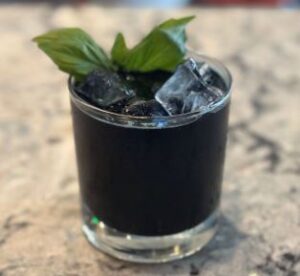
THE BAR AT CURE NAILHOUSE
“We deserve nice things,” she says simply.
Having spent time in a wide range of environments across retail, hospitality, and wellness, she felt there was a gap – especially in spaces centered around nail work – that balanced both beauty and depth. Cure was her way of answering that.
“I’ve never seen anything like this in a space centered around nails,” she says. “I wanted it to feel like home …like you’re surrounded by love, care, and attention.”
Every detail, from the lighting to the music to the overall mood, is curated with that intention in mind. The goal isn’t just how the space looks, but how it makes people feel.
“People can go anywhere to have their nails done,” she says. “But when you take the time to curate the vibe, that becomes part of a bigger experience.”
Cure, in that way, is an extension of Robinson herself. Something she has been building toward for years, and the feeling she has in the space is the same one she hopes others carry with them.
That perspective extends into how Robinson defines the work itself.
Nail art is a fine art practice. It always has been. We’re using the same materials as other artists, but it’s typically done in a setting that’s more commercial and seen as care work. But these are artists creating miniature sculptures and telling stories through their work. This is painting, it’s just happening on a different scale.
Cure asks people to reconsider that distinction. Not by explaining it outright, but by creating a space where the work speaks for itself – where the level of detail, intention, and creativity is undeniable.
At the same time, Robinson sees Cure as something rooted in Detroit, and reflective of what already exists here.
“We’ve never had a problem expressing ourselves,” she says. “There are so many artists in Detroit who have found their way.”
Her goal is not to introduce something new, but to create a space that reflects and elevates that existing talent. “I want Cure to reflect the city’s creativity, its brilliance,” she says. “To preserve that and put it forward.”
That vision extends beyond the work happening at each station. Robinson sees Cure as a place for gathering, for education, for experimentation, and ultimately, for pushing the boundaries of what a beauty space can be.
“We’re constantly teaching people why we don’t call ourselves a nail salon,” she says. “We’re challenging those ideas.”
As always, be sure to subscribe to our newsletter for regular updates on all things Detroit and more.