
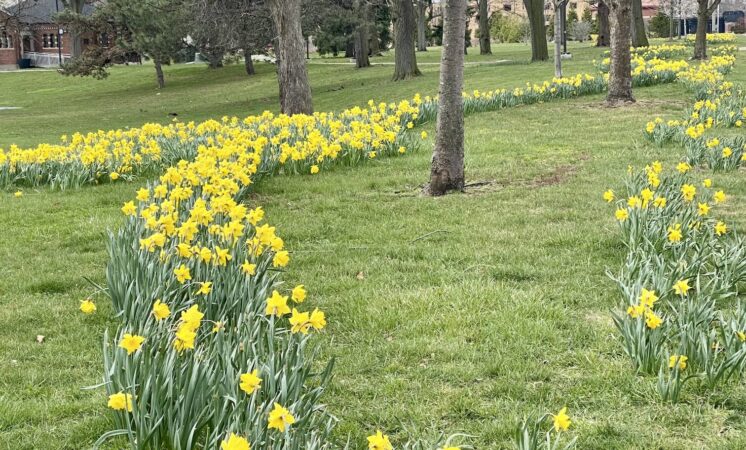



Each Spring, Detroit turns yellow.
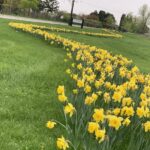
It happens in pockets across the city – along road medians, in neighborhood parks and in public spaces that, for a few weeks, feel transformed. On Belle Isle, where the plantings are most concentrated, entire hillsides come into bloom. Families walk through them. Photographers line up for shots. People linger, sit, even nap among the flowers.
It’s a display rooted in a simple idea – bringing a sense of hope to the city.
In 2008, that idea took shape during one of Detroit’s most difficult times.
“It was a depressing era,” says Robin Heller, chair of Daffodils4Detroit. “People were feeling downtrodden. There was a real sense that we needed something uplifting.”
The inspiration came from New York. After 9/11, the Netherlands sent more than a million daffodil bulbs to the city as a gesture of support – flowers that were planted across public spaces as a symbol of renewal. The idea resonated in Detroit and a luncheon was organized, bringing together people interested in Belle Isle, gardening and the future of the city. The goal was simple: raise enough money to purchase bulbs and plant them somewhere visible.
“The intent was to do something uplifting,” Heller says. “Daffodils are associated with hope and rebirth.”
The first planting took place on Belle Isle. It was small, but those involved had passion.
“We planted maybe a thousand bulbs that first year,” Heller says. “It was very grassroots. We had trowels and rock-hard dirt.”
But it gained momentum. As word spread, more people showed up, more bulbs were purchased and the luncheon grew, drawing supporters and funding. The tools evolved – from trowels to drills, then augers, and eventually trenchers that allowed for larger-scale planting. The Michigan Department of Natural Resources became a key partner, helping to expand the scope and efficiency of the work.
“The state was a great partner too, as was the city,” Heller says.
In 2017, the effort drew the attention and support of Mayor Mike Duggan, who publicly backed the initiative, committing Detroit to planting one million bulbs in a two-year period. The city invested in specialized bulb-planting equipment capable of planting up to 50,000 bulbs a day under the right conditions.
“That really accelerated things,” Heller says. “It focused the city on what we were doing.”
Early on, the group set a goal of planting one bulb for every Detroit resident – roughly 650,000. That milestone was reached. Then the goal expanded to four million, representing the broader metro area. That, too, has been achieved.
Today, the number is even more ambitious.

“We’ve planted over 4.5 million, and we’re still going,” Heller says. “Now we’re setting our sights on 10 million to represent the population of Michigan.”
The recognition has extended beyond the city as well. At one point, Heller came across coverage of Daffodils4Detroit in a monthly calendar in USA Today.
“I remember thinking, we’ve finally made it,” she says.
While Belle Isle remains the visual centerpiece – home to what is now officially recognized as Daffodil Hill, with signage planned to mark the space – the plantings have expanded well beyond it. Daffodils now appear across other city parks, in medians and in public spaces throughout Detroit, creating a network of blooms that signal the arrival of Spring.
“It’s still very Detroit-centric,” Heller says. “That’s always been important to us.”
Despite its scale, the project remains entirely volunteer-driven.
“There’s no paid staff,” she says. “It’s all volunteers.”

Partnerships with the City of Detroit, the Michigan DNR and the Belle Isle Conservancy have been critical, along with support from donors and sponsors who help fund the purchase of bulbs each year.
The annual luncheon, held at the Detroit Yacht Club, has become a cornerstone of the effort, both as a fundraiser and as a way to keep the project connected to the community. Drawing more than 400 attendees this year, it has evolved into something more than a traditional event, bringing together voices and perspectives that reflect the city itself.
Speakers are intentionally Detroit-rooted and often relevant to transformations happening in the city. Over the years, that has included figures like Susan Mosey and Dan Carmody, along with leaders connected to major developments such as the Gordie Howe International Bridge. Upcoming programming continues that approach, with speakers like David Carlton discussing the restoration of the Belle Isle Boathouse.
We try to keep it fresh, Heller says. It’s not just about the flowers, it’s about what’s happening in Detroit.
The luncheon also plays a critical role in sustaining the work, helping to fund the purchase of bulbs and ensuring the project can continue to grow year after year.
That sense of community has also extended into Detroit’s creative circles. Over time, local artists have contributed their own interpretations of the daffodils, creating pieces that reflect the project’s visual identity and meaning.
Artists and makers such as Laurie Tennent, Rebel Nell founder Amy Peterson and Little Cottage Designs’ Judy Duffy have all incorporated daffodil-inspired elements into their work. More recently, a local artist introduced a refreshed visual interpretation of the flowers, offering a new perspective on a familiar symbol.
“People want to be part of it in different ways,” Heller says. “It’s been amazing to see how it has evolved beyond the plantings.”
That organic growth is reflected in how Detroiters engage with the daffodils themselves.
“People will call and ask, ‘Are they in bloom yet?’” Heller says. “It’s really taken off on social media. There are a lot of photographers.”
What stays with her most are the everyday moments that happen within it.
“I remember early on, someone took a photo of children playing in the daffodils near the conservatory,” she says. “They had these joyful expressions, just running through the flowers. And I thought, this is what we wanted. There is hope. Detroit will come back.”
Today, those moments repeat themselves across the city each spring.
Families walk through the blooms. Couples stop for photos. People pause in the middle of their day to take it in. What began as a small act of optimism has become a shared seasonal experience—one that returns year after year, regardless of circumstances.

NAPPING IN THE FLOWERS
“It’s a beautification project, but it’s more than that,” Heller says. “It makes people feel better. It makes them feel embraced.”
The work continues, with thousands of bulbs planted annually and new opportunities to expand into additional spaces. At the same time, the focus remains consistent: keep it local, keep it visible to the public and keep it rooted in the original intent.
“My hope has always been that I see the rebirth of Detroit in my lifetime,” Heller says. “And I’m happy to say I am seeing it. I can’t tell you how excited that makes me.”
As the daffodils return each spring across Belle Isle, through city parks and along everyday streets, they offer a quiet, visible reminder of that progress.
Not just where the city has been, but where it’s going.
As always, be sure to subscribe to our newsletter for regular updates on all things Detroit and more.