
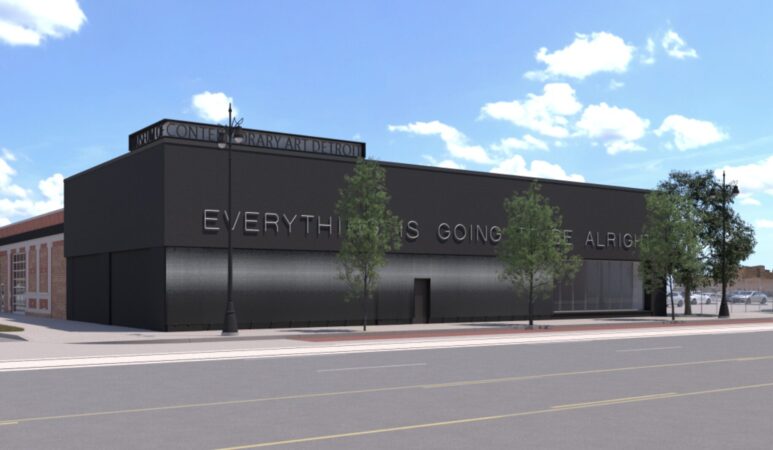



On April 25, the Museum of Contemporary Art Detroit (MOCAD) will reopen its doors following a significant renovation — one that reaches far beyond fresh walls or updated finishes. Housed in a former auto dealership designed by legendary Detroit industrial architect Albert Kahn, the museum’s building has long embodied the city’s industrial past. Now, it also reflects a more expansive vision for its future.
For Jova Lynne and Marie Ann Madison-Patton, Co-Directors of MOCAD, the renovation was never about aesthetic overhaul. It was about responsibility — to artists, to audiences, and to Detroit itself.
“When we began thinking about the future of the museum, we were really asking ourselves what it means to be truly accessible – not just conceptually, but physically and operationally,” Lynne explains. “Accessibility isn’t only about admission policies or programming; it’s about whether people can comfortably spend time in the building, whether artists can trust us with their work, and whether our staff can sustainably do their jobs.”
The most urgent needs were largely invisible. Foundational improvements like HVAC improvements and climate control were critical.

MARIE MADISON-PATTON AND JOVA LYNNE
“Climate control is essential for caring for artists’ work, especially when we’re showing pieces that are sensitive to temperature and humidity fluctuations,” says Madison-Patton. “At the same time, it directly impacts the comfort of our visitors and staff. Detroit’s seasonal extremes are real, and if we want people to gather, linger, and return, the environment has to feel welcoming year-round.”
These improvements allow MOCAD to host more ambitious exhibitions, including media-based works, installations and loans that require strict environmental standards, while also expanding the museum’s programming flexibility across all seasons.
In that way, infrastructure becomes something larger than mechanics. “These upgrades are really about stewardship and possibility,” she adds. “Infrastructure becomes a form of care: care for artists, care for audiences, and care for the long-term sustainability of the institution.”
MOCAD’s building has always been integral to its identity. The rawness of the former dealership like exposed materials and industrial scale shaped the museum from the start. The renovation, led in partnership with architectural firm PLY+, approached that character as something to amplify.
“The building’s industrial character wasn’t just a backdrop, it was central to how we approached the renovation,” Lynne says. “From the very beginning, we wanted to honor that history rather than erase it.”
Instead of a makeover, the team pursued a thoughtful adaptation of industrial space for contemporary use. Strategic changes improve visibility, flow and accessibility while maintaining the grit and spatial logic that make the structure distinctly Detroit.
The shop has been relocated to the front of the building with direct access to the café, creating a more welcoming entry. A permanent Learning Studio has been added within a former retail area, formalizing what has long been part of MOCAD’s DNA: intergenerational exchange, experimentation and community-based knowledge production.
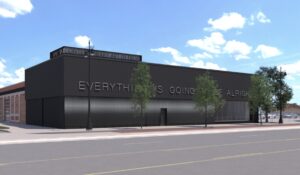
“PLY+ helped us amplify the industrial character so that each intervention enhances accessibility, visibility and flow,” Madison-Patton explains. “The redesigned Woodward Avenue façade invites people in more openly, while the building’s original materiality continues to tell the story of Detroit’s industrial legacy.”
The reopening arrives at a time when Detroit’s physical and economic landscape continues to evolve. New development, renewed attention and shifting demographics are reshaping neighborhoods and skylines. In that context, cultural institutions face pressing questions about relevance and responsibility.
“As development reshapes neighborhoods and skylines, institutions like MOCAD have to ask: who is this growth for? Who gets to feel reflected in it? Who has access to it?” Lynne says.
Their 20th anniversary year is guided by A Practice of Multiplicity – a framework that mirrors Detroit itself: layered, intergenerational and expansive.
“It recognizes that there isn’t one Detroit story, but many,” she explains. “At a moment when Detroit is being reimagined in very visible ways, we’re asserting that artists, cultural workers and communities are central to that evolution.”
The reopening season intentionally spotlights Detroit-area artists, including Olayami Dabls, Carole Harris and Martha Mysko. The decision, they say, was deliberate.
“Opening the season with Detroit-area artists is a statement that what happens here is not peripheral to the national discourse, it actively informs it,” Madison-Patton says. “Too often, ‘local’ and ‘international’ are framed as separate tiers of relevance. We reject that hierarchy.”
For MOCAD, Detroit is not a backdrop but a lens through which national conversations about post-industrial transformation, Black cultural production, community self-determination and public space are refracted.
Beyond exhibitions, the redesign also formalizes MOCAD’s role as a civic space. The café has been transformed into The Knight Community Commons through partnership with the Knight Foundation, reinforcing the museum as a site to gather and connect. Programs like Community Care provide rapid-response workshops addressing wellness, safety and collective healing.
“Ten years ago, it may have been enough to present rigorous exhibitions and public programs,” Lynne says. “Today, communities are asking cultural institutions to be more present, more porous and more human. Museums are no longer solely spaces for exhibition – they are spaces for sanctuary, experimentation and dialogue.”
The renovation signals that MOCAD sees itself not simply as a venue for contemporary art, but as an active anchor within Detroit’s cultural ecosystem.
“We’re not just trying to bring more people through the door,” Madison-Patton says. “We want visitors to see themselves not as passive viewers, but as participants in an ongoing cultural conversation.”
Looking ahead five years, they say success is measured not in square footage or attendance alone, but in resonance.
“We envision a museum that continues to champion radically creative practices – work that reflects the spirit of Detroit: resilient, inventive, layered and forward-thinking,” she says. “If more people across generations and backgrounds see MOCAD as a place to gather, to learn, to question and to imagine, that’s success.”
As always, be sure to subscribe to our newsletter for regular updates on all things Detroit and more.