



Detroit has long been a city defined by movement. Built on the automotive industry and a culture of hard work, it’s a place where energy rarely sits still. Yet over the past few decades, another kind of movement has taken root across Metro Detroit, one built not on speed or production, but on breath, stillness and community.
Yoga has become an increasingly visible part of Detroit’s wellness landscape, growing through studios, independent teachers and a network of practitioners who move fluidly between spaces. Unlike some cities where studios compete fiercely for loyalty, the yoga culture here has developed with a different rhythm – one shaped by collaboration, shared lineage and an openness that allows teachers and students to circulate across studios, events and communities.
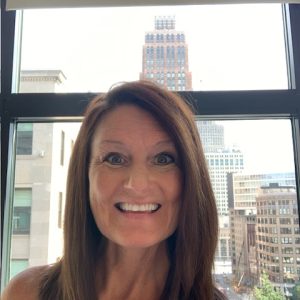
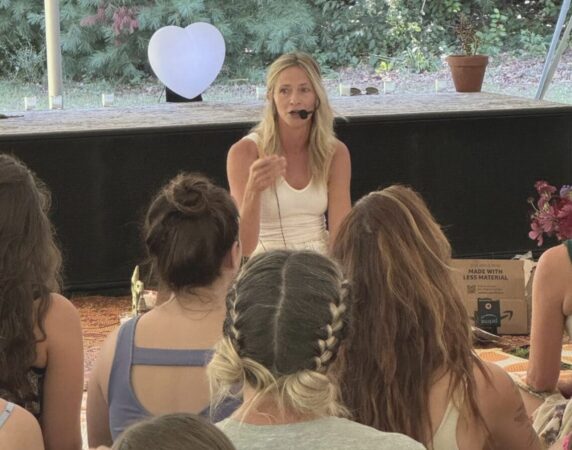
Few people have witnessed that evolution as closely as Beth James. James has been teaching yoga in the Detroit area for more than two decades, watching the region’s practice expand from a relatively small network of instructors into a broad, interconnected community of studios, teachers, and students.

BETH JAMES
Her own journey into yoga began with an introduction from her mom, right after college where she studied anthropology. As a former high school runner, she was already comfortable with physical movement, but yoga connected different elements she hadn’t experienced before.
“Yoga connected the dots for me the way movement, stillness and breath could create this feeling in your body and mind,” she said. It also helped me step away from things that weren’t serving me and follow what did and I ended up wanting to share that with others.”
She got certified and never looked back, launching a teaching career that placed her within a network of instructors who helped shape what yoga looks like in Metro Detroit today.
In many ways, Detroit’s yoga culture can be traced through a kind of lineage. Early teachers trained hundreds of students, many of whom later became instructors themselves, opening studios, leading trainings and mentoring the next generation. As those students became teachers and those teachers trained others, a ripple effect spread throughout the region.
The result is a yoga community that shares common roots while still evolving.
“A lot of the style of yoga we see here grew out of a handful of key teachers who trained so many people,” James explains.
One of the defining characteristics of Detroit’s yoga classes is the emphasis on flow-based movement combined with thematic storytelling. In many studios across the region, teachers weave together physical sequences with philosophical ideas, personal reflection or broader life themes.
That style isn’t necessarily common everywhere. Having spent time in other yoga communities, including Portland and Hawaii, James has noticed how distinctive the Detroit approach can feel.
Detroit’s broader culture may play a role in that dynamic. A city built on motion and productivity might seem like an unlikely place for practices centered on stillness and breath. Yet for many people, that contrast is precisely what makes yoga meaningful here.
“People here are busy,” James says. “They work hard, they have full lives. Yoga gives them a space to balance that out.”
Interestingly, Detroiters often arrive at stillness through physical intensity.
“In order for people to really drop in, it often has to be physical first,” James says. “They want to feel like it’s worth their time, like they’re working hard. Then the stillness comes.”
Over the years, as both teachers and students have aged and evolved, the practice itself has expanded.
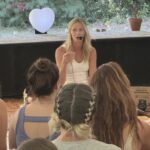
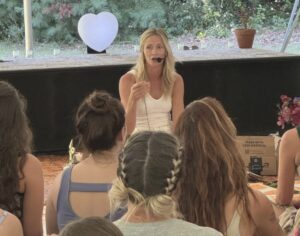
BAREFOOT AND FREE YOGA FESTIVAL
“When I started, there was a lot of vinyasa yoga. Now there’s much more variety. As people age, their bodies need different things.”
Beyond the physical practice, what has helped yoga endure in Detroit is something less tangible but equally powerful: community.
“Yoga has lasted as long as it has because of community,” she says. “People come for various reasons, but once they’re in that space, they start connecting with other humans.”
In an era when many people work remotely and spend much of their time interacting through screens, the yoga studio becomes one of the few environments where people gather regularly in person.
“You walk into a class and suddenly you’re in a room with people from different backgrounds, different ages, different professions,” James says. “The thing you have in common is yoga, but you’re still very different.”
That diversity creates unexpected bonds. “People crave that,” she says. “You can see how meaningful those connections become.”
The collaborative nature of Detroit’s yoga scene reinforces those relationships. Teachers often lead classes at multiple studios, and students frequently follow instructors from one location to another. Rather than rigid boundaries between spaces, the community tends to move together.
“In some places there’s a lot of division,” James says. “If you teach at one studio, you don’t go to another. There can be a competitive culture.”
Detroit, she says, has developed differently.
“Here, teachers move around more,” she explains. “They teach at different studios, they practice at different places, they support each other. It actually makes the community bigger.”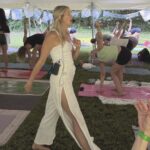
In 2013, that same spirit of collaboration inspired James to pursue a yoga festival that could bring the region’s teachers and students together in one place.
At the time, yoga festivals were gaining popularity in cities like Denver, New York and Los Angeles, often featuring celebrity instructors and large national followings. But the Midwest had relatively few events of that scale.
What began as a dream gradually became the Barefoot & Free Yoga Festival, which has grown into one of the largest yoga gatherings in the Midwest.
Today the festival brings together more than 100 teachers and wellness practitioners, attracting around 1,000 attendees each year. Participants move between classes, workshops and wellness experiences throughout the event, sampling a wide range of practices.
“It’s like a sampler platter of yoga styles,” James says.
The festival reflects the collaborative nature of Detroit’s yoga culture. Many of the instructors who participate have taught in studios throughout the region, while others travel from across the country—and occasionally from abroad—to share their work.
“We’ve had teachers come from places like Brazil,” James says. “Last year we had someone from Chicago originally from Lithuania.”
Despite that growing reach, the event has maintained a grassroots character.
“A lot of people come because a friend recommended it or their teacher mentioned it,” James says. “It’s still very community-driven.”
Looking ahead, James believes yoga will continue to play an expanding role in Detroit’s lifestyle culture, particularly as younger generations show increasing interest in health, longevity and in-person connection.
“There’s definitely a shift happening,” she says. “A lot of younger people are really interested in wellness. They’d rather go somewhere and meet others share that interest versus spending time in bars.”
After more than 20 years of teaching, James says the most powerful lesson the practice has revealed is something deeply human.
“People crave community,” she says. “What keeps them coming back—to yoga, to retreats, to festivals—is the chance to meet people, to be themselves, to feel like they belong.”
In a time when loneliness and disconnection are widely discussed across the country, those spaces have become increasingly valuable.
“Years ago people found that sense of belonging in churches or small towns,” James says. “As people move away from those structures, they still need places to gather.”
In a city built on motion, the simple act of pausing together may be one of the most powerful movements of all.
As always, be sure to subscribe to our newsletter for regular updates on all things Detroit and more.