



Starting a food business can look deceptively simple from the outside. But for many entrepreneurs, especially in the early stages, the reality quickly becomes far more complex.

Jennyfer Crawford-Williams, founder of Ask Jennyfer, All Things Detroit and All Things Marketplace
“I think a lot of people underestimate how many moving parts come with starting a food business,” says Jennyfer Crawford-Williams, founder of Ask Jennyfer, All Things Detroit and All Things Marketplace. “People may have an amazing product or recipe, but then you’re navigating licensing, commercial kitchens, packaging, pricing, permits, staffing, marketing, and figuring out how to actually get in front of customers.”
That gap between talent and access is one of the core challenges organizations across Detroit’s entrepreneurial ecosystem are working to address. Through initiatives supported by the Gilbert Family Foundation, entrepreneurs are increasingly finding not just isolated resources, but a connected network designed to help businesses move from idea to visibility, revenue and long-term growth.
For Wafa Dinaro, Executive Director of the New Economy Initiative (NEI), one of the biggest obstacles for entrepreneurs is often simply knowing where to begin.
“The first real hurdle is knowing where to start,” says Dinaro. “That’s why the New Economy Initiative created MI Small Business Helper, a one-stop shop for entrepreneurs to connect with resources that can help them get to the next step faster.”
MI Small Business Helper convenes more than 100 vetted organizations and resources designed to help entrepreneurs navigate the often overwhelming realities of launching and growing a business. Within the food sector specifically, organizations including Eastern Market and Fair Food Network’s Michigan Good Food Fund help support entrepreneurs as they move from concept to operation.
But both Crawford-Williams and Dinaro emphasize that the larger goal is not simply providing one-time assistance. Instead, the focus is on building a broader support ecosystem capable of meeting entrepreneurs at different stages of growth.
“With the Gilbert Family Foundation it’s not just about one event, one grant, or one conversation,” says Crawford-

Linda Nosegbe, Director of Economic Mobility, Gilbert Family Foundation
Williams. “Building an ecosystem means entrepreneurs can enter at different stages and still find support. Maybe someone starts with education and resources, then moves into vending opportunities, then gains visibility, then builds relationships that lead to long-term growth.”
Dinaro says the Gilbert Family Foundation’s long-term investment approach has been critical in helping strengthen that system of support.
“Gilbert Family Foundation has been incredibly thoughtful in how they are investing in small businesses, entrepreneurs and founders,” she says. “Their multi-year commitments and dedication to Detroit’s growth signal that this is not a short-term effort, it is a long-term investment in the city’s residents and its economic future.”
That long-view approach has helped initiatives like MI Small Business Helper connect entrepreneurs not only to technical resources, but also to mentorship, funding pathways and customer-facing opportunities.
Programs such as Venture 313, Downtown Detroit Small Business Markets and MI Small Business Helper all serve different purposes within that larger ecosystem.
Each program fills a different gap. Some entrepreneurs need foundational help – understanding how to structure the business, become compliant, or access resources. Others are ready for visibility and customer acquisition. Then you have businesses that are prepared to scale and need access to larger audiences and opportunities,
says Crawford-Williams
Together, she says, the programs create “a pipeline where businesses can continue evolving instead of feeling stuck after one step.”
Dinaro sees it similarly.

Wafa Dinaro, Executive Director of the New Economy Initiative (NEI)
“Each one meets entrepreneurs where they are,” she says. “Whether someone needs help clarifying their idea, building a business plan, accessing capital or finding their first customers, there is a program designed to support that stage of the journey. Together, they form a connected ecosystem rather than a collection of isolated services.”
That support can be especially important in food entrepreneurship, where operational realities often arrive long before stability or revenue.
“Honestly, guidance is just as important as capital, sometimes even more important in the beginning,” says Crawford-Williams. “I’ve seen people get funding but still struggle because they didn’t have the mentorship, strategy, or understanding of what comes next.”
Dinaro agrees that talent alone is rarely enough without the infrastructure to support it.
“Some people are great at baking cupcakes but may not know how to translate that talent into owning and operating a business,” she says.
To help that future entrepreneur succeed, we have to guide them by connecting them with technical assistance and capital so they can share their talents with the community,
says Dinaro.
For many entrepreneurs, early traction often begins through markets, catering, pop-ups and word-of-mouth exposure. But visibility remains one of the industry’s largest barriers.
“Idea to revenue usually starts with pop-ups, markets, catering, social media, or word of mouth, and then hopefully grows into consistent opportunities,” says Crawford-Williams. “But the friction points are real.”

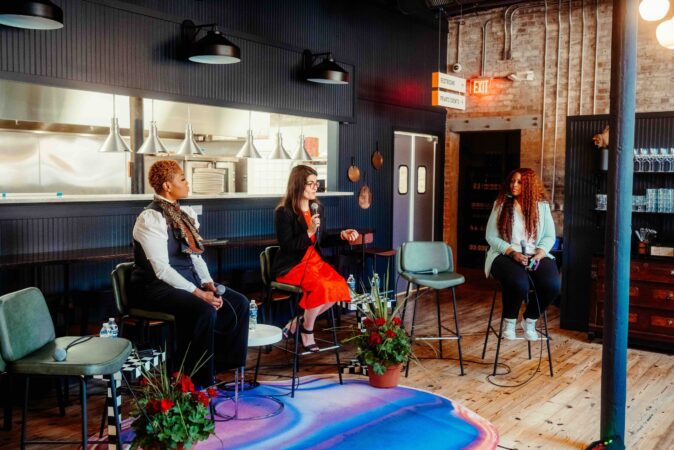
In discussion at Business of Food Summit 2026
Access to affordable commercial kitchen space, licensing requirements, staffing, supplies and marketing all remain persistent challenges. Just as importantly, many businesses struggle simply because potential customers do not yet know they exist.
“That’s why events like All Things Detroit, which put entrepreneurs directly in front of customers, matter so much,” she says.
Spaces like the Downtown Detroit Small Business Markets have become important not only for sales, but also for testing, feedback and long-term visibility.
“Entrepreneurs get immediate feedback from real consumers,” says Crawford-Williams. “They can see what resonates, what sells, and what needs improvement. It also builds visibility in high-traffic areas where people may discover a business for the first time.”
Dinaro says those environments also create something equally valuable: community.
“Entrepreneurs are talking to each other, learning from each other and realizing they are not in this alone,” she says. “That part is priceless.”
Examples of that ecosystem in action are already emerging across the city.
Dinaro points to Mushroom Angel Company founders W.E. and Dominique Da’Cruz, who relocated from New York to Detroit after recognizing the strength of the city’s entrepreneurial support network. With the help of several organizations, the company moved from concept to production and eventually landed products in Meijer stores across multiple states.
For both Crawford-Williams and Dinaro, Detroit’s future food economy already exists within the city’s entrepreneurial community. The challenge now is continuing to close the gap between talent and access.
“There are so many incredible food entrepreneurs with amazing products, but they don’t always have access to capital, commercial spaces, information, or networks,” says Crawford-Williams. “If we could close that gap, I think we’d unlock so much innovation and economic growth in Detroit.”
Dinaro echoes this, saying, “The next Domino’s or Little Caesars is already here,” she says. “They are already in the community, already building something real. We just have to make sure the support is there to help them go all the way.”
As always, be sure to subscribe to our newsletter for regular updates on all things Detroit and more. See more from the 2026 Business of Food Summit here.