



Over the last several years the Detroit riverfront has been steadily transforming into both a destination and an experience. Parks, greenways and public spaces have reshaped how the city connects to the water, creating a stretch that’s dynamic and open to all walks of life.
The arrival of the JW Marriott Detroit Water Square marks a new phase in that evolution.
Set directly along the Riverwalk, the hotel does more than add another building to the skyline. It introduces a new point of connection.
For Scott Stinebaugh, Pre-Opening Director of Sales and Marketing, the project reflects the broader momentum happening across Detroit.
Having spent more than three decades in the hospitality industry – much of it in the city – he has witnessed Detroit through both challenging periods and its ongoing resurgence.
“I’ve become such a fan and supporter of Detroit,” he says. “I’ve seen some of the city’s toughest times, and I’ve seen some of its best that are happening right now. This project represents that continued growth and connectivity.”
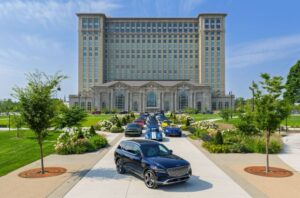
Stinebaugh was part of the team that opened the Westin at Detroit Metropolitan Airport and more recently spent nearly two decades at the Book Cadillac Hotel, a project widely seen as a turning point in Detroit’s downtown revival.
“That was kind of a catalyst,” he says. “A beacon of hope at the time.”
The JW Marriott project, he says, feels like a continuation of that, but in a part of the city that many people have not fully experienced.
For years, much of the west riverfront remained difficult to access, shaped by infrastructure that limited how people moved through and experienced the space. As the Riverwalk has expanded and surrounding developments have taken shape, that dynamic has shifted.
“With the extension of Second Avenue, everything happening along the Riverwalk and Ralph C. Wilson Jr. Centennial Park, it’s all coming together,” Stinebaugh says. “It’s an exciting time to introduce something like this.”
The design builds on that same feeling of connectivity and forward movement.
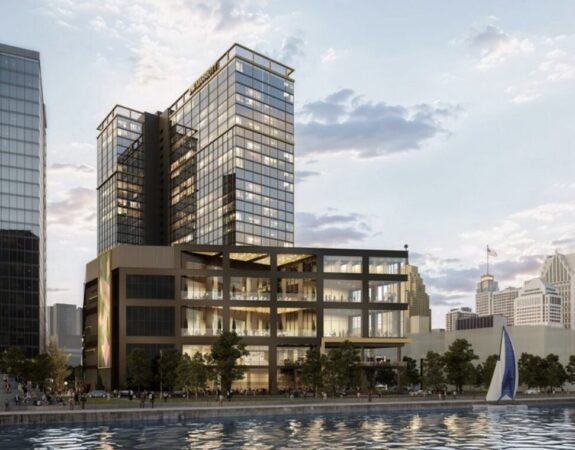
“The building has a special and unique relationship with the water,” Stinebaugh says. “The architecture really takes full advantage of that.”
Glass plays a central role, creating a structure that reflects and responds to its surroundings.
“It’s a shimmering glass exterior,” he says. “Everywhere you look in the building, there’s a view – guest rooms, food and beverage spaces, ballrooms. There’s a tremendous amount of natural light.”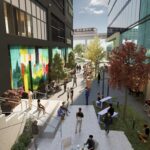
Inside, that relationship to the water continues in more subtle ways. Design elements throughout the building echo movement and flow, from lighting installations to architectural details that draw inspiration from waves.
“You’ll see it in the artwork, even in the ceiling design in some of the spaces,” he says. “There’s a consistent thread that ties it back to the water.”
Materials reinforce a contemporary aesthetic while maintaining warmth. The overall experience is meant to feel elevated without being overwhelming.
“A hallmark of the JW brand is mindfulness,” Stinebaugh says. “It’s about creating spaces that feel calming and balanced, where people can come in and actually feel better when they leave.”
Beyond design, the project also reflects a strategic shift in Detroit’s hospitality ecosystem.
Despite being home to the 16th largest convention center in the country, Detroit’s hotel package hasn’t always supported that. The JW Marriott begins to change that dynamic.
“This gives us the ability to elevate Detroit’s appeal on a global stage,” he says. “It allows us to go after business that we haven’t been able to capture in the same way before.”
With 601 guest rooms, including 44 suites, and more than 53,000 square feet of meeting space – anchored by two large ballrooms with floor-to-ceiling windows and outdoor terraces – the hotel is designed to accommodate both large conventions and smaller, high-end gatherings.
The surrounding space has been designed to invite both guests and the broader community, with landscaped areas, public art and outdoor seating that extend the experience beyond the building itself.
“We look at it as an urban oasis,” he says. “An urban resort without a golf course.”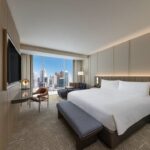
To that end, outdoor terraces are integrated throughout the property, from dining spaces to event areas, allowing guests to engage with the riverfront in multiple ways.
“Any opportunity we have to bring people outside and connect them to the space, we’ve taken advantage of,” he says.
Food and beverage offerings also play a role in shaping that experience, from the lobby bar, The Assembly, to The Veranda restaurant and the return of a familiar Detroit name: Joe Muir Seafood and Chophouse.
“That has a lot of history in the city,” Stinebaugh says. “There’s a connection there that people recognize.”
Taken together, the goal is to create a place that draws people in for a range of reasons—whether for a stay, a meal, an event or simply time along the river.
Looking ahead, Stinebaugh sees the hotel becoming more than a destination, but something that is woven into the city’s daily life.
“Success, for me, is the hotel becoming a social hub,” he says. “A place where people come to see it, experience it, stay, gather.”
He also sees it as part of a larger shift taking place along the west riverfront, where new development is beginning to take shape and draw attention.
“This can be a catalyst,” he says. “It brings more awareness to this part of the city and helps connect it.”
In that sense, the JW Marriott Detroit Water Square is another step in how Detroit is redefining its relationship with the river.
“It becomes another piece of the fabric that connects the city,” Stinebaugh says.
As always, be sure to subscribe to our newsletter for regular updates on all things Detroit and more.