



More than a decade after Kyle Hoff and Alex O’Dell launched Floyd a brand built in Detroit, as the furniture company has refined its focus around what it does best.
Floyd has expanded into new product categories, navigated the pandemic-era home boom, worked through supply chain issues and tariffs and experimented with different approaches to physical retail. Through those changes, the company has continued to return to the idea behind its earliest products: creating adaptable furniture systems designed to evolve over time.
“At that point, we were really focused on adaptability and modularity,” Hoff said of the company’s early approach.
Hoff was 25 years old and had moved several times, bringing an IKEA bed from Ann Arbor to Chicago and through different living situations. Those moves got him thinking about how furniture was designed for a particular place rather than the different stages of a person’s life.
The question became how to make furniture that could change along with the person who owned it.
Floyd launched its first product, the Floyd Leg, through Kickstarter in 2013. The company later introduced its Bed Frame, which remains one of its core products today. Hoff and O’Dell have continued developing the Bed Frame system, recently adding options including storage, an upholstered add-on and a side table with an integrated light.
That approach has become more central as the company has matured.

FLOYD GW HOME
Hoff says there were periods when Floyd moved more broadly across the home category. During the surge in home spending in 2020 and 2021, the company expanded its assortment, including accessories and outdoor furniture, as consumers invested heavily in their living spaces.
The expansion helped Floyd learn more about what its customers were actually looking for from the brand.
“We realized people were coming to Floyd for distinct product design, adaptability and additions,” Hoff said.
That realization prompted the company to concentrate more heavily on its core products and the systems built around them. Hoff describes Floyd today as more of a product company than a broad lifestyle brand, with an emphasis on developing proprietary pieces that can remain relevant for years and continue to evolve through additions and updates.
“We have evergreen products now that people have owned for a decade and can still add onto,” he said. “That’s what distinguishes Floyd.”
The path has included plenty of challenges. Floyd began during the rise of direct-to-consumer ecommerce, then encountered the supply chain disruptions that affected the home furnishings industry during the pandemic. Tariffs have created another significant challenge, even as the company has maintained domestic sourcing for many of its products.
In 2025, Floyd was acquired by Rize Home, a Michigan-based furniture manufacturer. Hoff says the partnership has helped address some of the operational challenges Floyd encountered as it grew while also giving the company a stronger foundation for its next phase.
“The partnership with Rize has been really impactful in helping us set up a more reliable supply chain and created a better platform for supporting retail,” Hoff said.

FLOYD BED
There have also been products and ideas that did not perform as expected. Hoff sees those experiences as part of understanding where Floyd fits within a crowded furniture market.
“There are so many things to learn and adapt to,” he said. “It helped hone the product and brand we are today.”
One area Floyd continues to explore is how customers experience those products in person.
Floyd began as an online business, which allowed it to reach customers well beyond Detroit. Over the years, the company experimented with physical experiences by renting homes and apartments in cities including Los Angeles, furnishing them with Floyd products and inviting customers inside.
Those experiments reinforced something particularly relevant to furniture: seeing a product online and living with it are different experiences. Customers may want to sit on a sofa, touch materials and understand how pieces work together before making a purchase.
That has made Floyd’s growing relationship with Gardner White a natural testing ground for physical retail in its hometown.
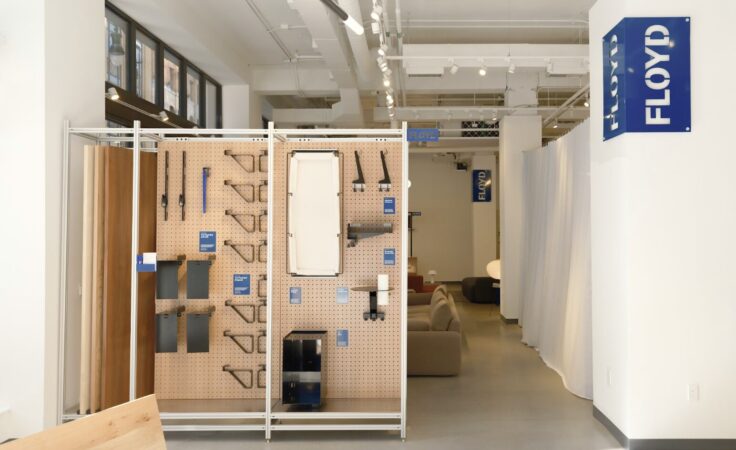
Floyd has a presence at GW HOME, Gardner White’s downtown Detroit concept on Woodward Avenue, where its products are displayed in a setting that allows customers to explore the collection and better understand how the systems work. The partnership has continued to develop, with Floyd recently expanding and reworking its footprint inside the store.
For Hoff, the location also carries some personal significance. He moved to Detroit in 2013, the same year Floyd launched and the city filed for bankruptcy. More than a decade later, seeing Floyd represented on Woodward reflects how much both the company and its hometown have changed.

THE BLOCK
“It’s exciting for us as a hometown opportunity,” Hoff said. “They’ve done a great job curating great brands and products and making it feel design-driven.”
He credits the Gardner White team with understanding Floyd’s products and helping customers navigate a furniture model that can require more explanation than a conventional showroom display.
“We’ve tested other forms of retail, but this has been a uniquely good fit,” Hoff said. “The team really likes the product and is good at talking about it.”
The relationship also gives Floyd another way to communicate the adaptability at the center of its designs. A physical space can show customers how components work together and how a piece might change as their needs change.
“How do we lean into what Floyd is as a system?” Hoff said. “How do we help people understand the modularity of the system and what it can be like in life over time?”
As Floyd looks ahead, Hoff is less interested in identifying a single major growth opportunity than in continuing to improve the areas the company has chosen to focus on.
That includes product development as well as some of the persistent challenges of the furniture business, such as shipping and customer support. Hoff believes Floyd’s relatively concise product offering can become an advantage, allowing the company to devote more attention to improving the products and the experience surrounding them.
The company is also continuing to consider how more customers can experience Floyd in person, building on what it has learned through its Detroit retail presence.
“We want to build this business for decades ahead,” Hoff said.
As always, be sure to subscribe to our newsletter for regular updates on all things Detroit and more!