



Few buildings are as recognizable in Detroit as the Renaissance Center. Its towers are a defining feature of the city’s skyline, appearing on postcards and in aerial shots during nationally televised sporting events. But the 5.3-million-square-foot complex was built for a different era, and its original purpose no longer reflects the needs of the city around it.

JAKE CHIDESTER
For Jake Chidester, vice president of strategic initiatives at Bedrock, preserving the Renaissance Center means reconsidering what the landmark can become.
Today, much of the complex sits empty, and its design makes it difficult to adapt to modern uses. Chidester sees an opportunity to transform the RenCen into a more accessible destination that connects more directly with downtown Detroit and the riverfront.
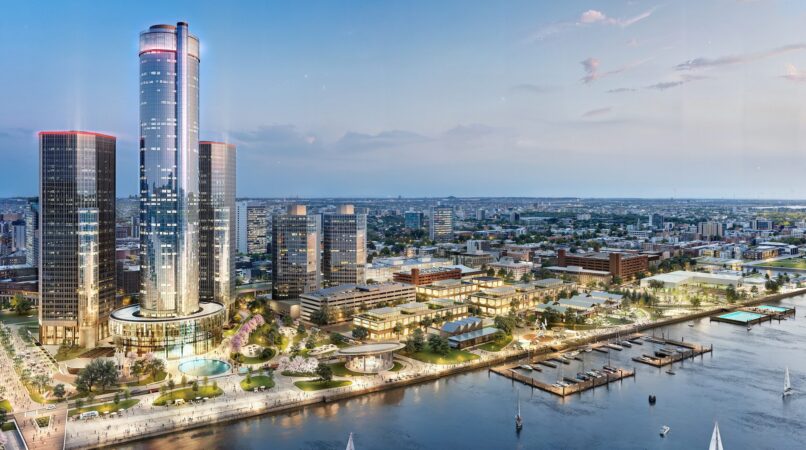
That thinking is central to a $2.2 billion redevelopment plan for the Renaissance Center and surrounding 35-acre east riverfront district, supported by Dan Gilbert’s recently announced pledge of approximately $1 billion to establish a nonprofit that will own, redevelop and operate the property.
Chidester says the plan preserves the central tower and two flanking towers while introducing new housing, commercial activity and public space. He describes the vision as ‘saving the icon by evolving it,’ allowing the building to remain viable for the next century.
The project is aligned with Bedrock’s approach to development in Detroit over the past 15 years. Chidester points to the company’s work along the Woodward corridor, where investments in public spaces, a mix of businesses and greater density have helped create active, connected districts.
“One of our core development theses, our city-building theses, is that stabilization comes through densification and the creation of place,” he says.
The work involves adapting the Renaissance Center while reconsidering the land surrounding it, strengthening connections to the waterfront and creating a district that functions as a cohesive destination.
Chidester says Bedrock and General Motors have been working on the redevelopment for approximately two and a half years, with the understanding that the investment would serve a civic purpose.

EAST RIVERFRONT RENDERING
“We went into this eyes wide open that this was never going to make a return for GM,” he says. “It’s always been a civic commitment.”
Gilbert’s contribution formalizes that commitment through a nonprofit structure. Neither Gilbert nor his companies will receive development profits, and his contribution will not be repaid. Revenue generated by the district will support operating costs, debt obligations and reinvestment in the property, with any surplus directed toward community benefit.
Chidester says the nonprofit structure helps ensure the project stays true to its commitment to Detroit and its residents over time.
The vision also extends well beyond the Renaissance Center itself.
Chidester credits the Detroit Riverfront Conservancy with turning underused waterfront property into one of the city’s most important public spaces over the past 25 years. He sees the RenCen redevelopment as an opportunity to build on that progress by bringing more activity, businesses and investment to the riverfront.
“The conservancy has done a great job with passive space,” he says. “What is the next step? It’s active space.”
The redevelopment will introduce restaurants, retail, housing, attractions and programming designed to bring people to the waterfront throughout the year. Approximately 18 acres of publicly accessible civic space will become a functional extension of the Detroit Riverwalk, allowing the waterfront experience to expand into the surrounding district.
Chidester describes the goal as creating a place that is “100 percent global and 100 percent local,” with an experience that feels authentically Detroit while attracting visitors from across the region and beyond.
The goal is to create a destination that Detroiters can enjoy regularly, with local businesses, programming and public spaces that bring people to the riverfront. Chidester also sees an opportunity to attract more visitors from outside the city.
As a father of four raising his family in Detroit, he often thinks about weekend trips to places like Chicago or Toronto. He believes Detroit has the potential to draw families from those cities for the same kind of experience.
The waterfront district could become an anchor for what he calls a “100-hour vacation in Detroit,” connecting visitors with the city’s neighborhoods, cultural institutions, restaurants and other attractions.
Making that vision meaningful for Detroit residents is also part of the project’s formal commitments.
Under a legally binding community benefits agreement, the development includes approximately $43.5 million in direct community program investments. Among the commitments are $10 million for small-business opportunities on the site and in Detroit neighborhoods, $8 million to operate a community hub offering free year-round activities, and $6 million for STEM programming and free parking for Detroit residents.
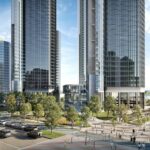
EAST RIVERFRONT RENDERING
The plan also calls for 20% of its housing to be affordable to households earning 60% of area median income, along with commitments related to Detroit hiring and workforce participation.
The development will take place over approximately ten years. Major construction is scheduled to begin in the third quarter of 2027, following the NCAA Final Four and Detroit Grand Prix. The first phase will include selective deconstruction, improvements to the central tower hotel, new multifamily housing and initial work on the east riverfront and marina, with completion targeted for 2032.
Additional housing and commercial development will follow in subsequent phases. Chidester says the sequencing is important to establishing enough activity early in the project to create a destination people will want to visit. The team is also coordinating with the Michigan Department of Transportation on the nearby I-375 project to align connections and infrastructure.
Beyond the redevelopment itself, Chidester hopes the project will help strengthen Detroit’s identity as an international waterfront city, building on its geography, history and connection to Canada.
He believes success will ultimately be measured by the people who use the district and whether it becomes both a valued part of daily life for Detroiters and a nationally recognized destination for visiting families.
“We are an international waterfront city,” he says. “I would hope we would claim our position as the premier international waterfront city in the U.S.”
As always, be sure to subscribe to our newsletter for regular updates on all things Detroit and more!