



When Will Branch first started cooking professionally more than 20 years ago, one idea kept coming back to him: How could he tell his own story through food?
That question eventually became Paper Sons, a modern Chinese-American barbecue concept blending Texas-style smoked meats with traditional Chinese flavors and techniques. Scheduled to open a brick-and-mortar location in Ferndale in 2027, the concept is currently making its way across metro Detroit through a series of pop-up dinners that offer an early look at the menu, and the philosophy behind it.
For Branch, founder of Detroit’s Corridor Sausage, Director of Culinary Development for E.W. Grobbel Sons, Inc., and one of the region’s leading authorities on smoked and cured meats, Paper Sons is about much more than combining two culinary traditions. It’s the culmination of decades spent exploring his own heritage while reflecting on where Detroit’s food scene is headed next.
“This is very much a concept that’s been rattling around in my head since I first started cooking 20 years ago,” Branch said. “I’m American-born Chinese. I grew up with traditional Szechuan cooking and my second love was barbecue. I wanted to see how those flavors could work together.”
While Texas barbecue and Chinese cuisine may seem worlds apart, Branch sees more common ground than people realize.
“Chinese culture has such a rich history of smoking, searing and grilling meats. It’s just done differently,” he said. “I wanted to take the flavor of a great Texas brisket and put that into a beautiful sweet and sour, bringing something new to the table.”
That approach is rooted as much in respect as creativity.
Throughout his career, Branch said he’s watched Chinese cuisine become oversimplified or reduced to familiar takeout dishes, often overlooking the care, technique and heritage behind the food.
“When it comes to food and the cultures behind it, I don’t like the argument over authenticity,” he
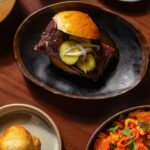
PAPER SONS. PHOTO TAYLOR HIGGINS
said. “To me, it’s about respect. Are you being respectful to the food and the culture you’re representing? We’ve all been to places where something gets put on the menu because it’s trendy. That’s what frustrates me. Right now, people want to tell more of a story through food, and when it’s personal, that’s when it’s at its best.”
Branch believes that desire to tell personal stories is shaping Detroit’s restaurant scene as well.
Looking back 10 to 15 years, he points to places like Mudgie’s, Supino and Selden Standard as restaurants that helped define neighborhoods and change how people experienced the city. Today, he sees another shift taking place.
“For a while there was a gold rush of outside groups coming into Detroit, and there were pros and cons to that,” Branch said. “Now I think people are starting to want to expand again, but we’re seeing a return to owner-operated, chef-driven restaurants where people are passionate about what they’re doing.”
He points to restaurants like Flowers of Vietnam, Supino’s continued expansion and other independently owned concepts as evidence that Detroit diners increasingly value experiences shaped by the people behind them.
“Food is probably the greatest neighborhood builder we have,” he said. “It brings people together from every part of the city.”
That philosophy also shapes the experience Branch hopes to create at Paper Sons. Rather than simply serving barbecue, he wants guests to feel as though they’ve been invited into his home.
“We want people to feel like they’re coming to a party in our house,” he said. “Someone might walk
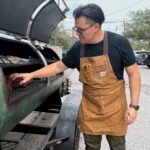
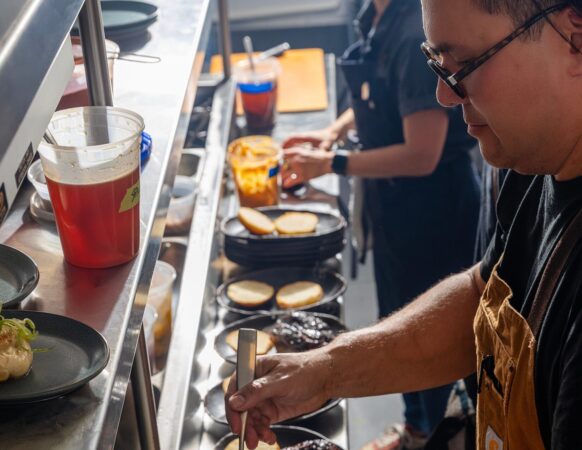
CHEF WILL BRANCH. PHOTO TAYLOR HIGGINS
in expecting a small barbecue place with brisket and ribs, look at the menu and think, ‘What did we get ourselves into?’ Then they try it and say, ‘I never thought of it that way.’ We want people to be surprised and delighted, then leave wanting to come back to the party.”
The restaurant’s name carries that same sense of personal history.
Paper Sons refers to a chapter of Chinese-American immigration history in which many immigrants entered the United States using fraudulent documents during the late 19th and 20th centuries. Branch sees it as a reflection of a shared family experience carried by generations of Chinese Americans.
“It’s almost unspoken, but nearly every family has a lineage of paper sons,” he said. “It’s a shared experience that we bring to the table.”
For Branch, the restaurant also bridges generations within his own family.
He remembers cooking alongside his mother and celebrating Chinese New Year with relatives in New York. Today, he’s creating new traditions, including having his 12-year-old daughter help make dumplings during Paper Sons pop-up events.
“I wouldn’t know these flavors if it weren’t for my mom and her family,” he said. “Now I’m making history with my own kids.”
Asked how his definition of success has changed since founding Corridor Sausage more than 15 years ago, Branch said his focus has shifted away from mastering technique and toward creating memorable experiences.
“As I’ve gotten older, it’s become more about the guest than it was before,” he said. “It’s about surprising people, delighting them and giving them an experience.”
Looking ahead, he hopes Paper Sons becomes part of a larger story about how Chinese-American cuisine continues to evolve.
He points to restaurants like Mr. Jiu’s in San Francisco and Bonnie’s in Brooklyn as examples of chefs using food to tell the story of a new generation while honoring the generations that came before them.
“We’re representing our heritage in a new manner,” Branch said. “Chinese cooking is so much more than takeout. There are so many ways to explore it. We have a unique voice and vision for what that can look like here.”
As always, be sure to subscribe to our newsletter for regular updates on all things Detroit and more.