
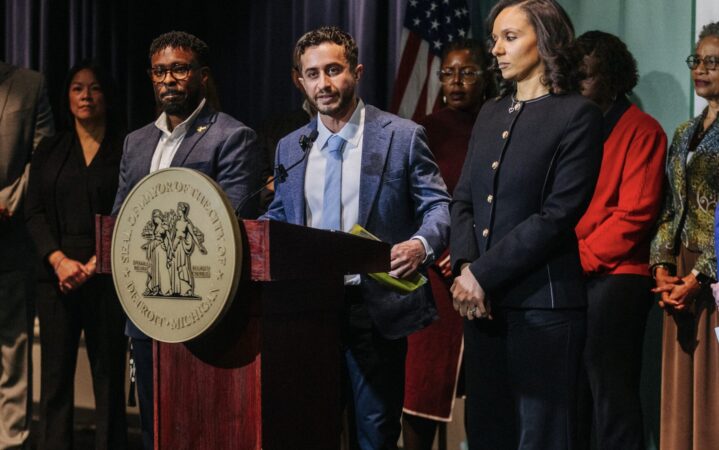



Mayor Mary Sheffield’s decision to appoint Ali Abazeed as Detroit’s Chief Public Health Officer in March reflected a broader vision for the city’s future – one where health is considered in every major decision, not just those made inside hospitals and clinics.
Her vision of making Detroit a “Health in All Policies” city means considering the health impact of everything from planning and zoning to housing, economic development and transportation. It’s an ambitious approach, and one Abazeed has spent much of his career preparing for.
For Abazeed, improving public health has never been about treating illness. It’s about understanding how the decisions governments make every day shape the lives, and ultimately the health of the people they serve.
“I believe the health outcomes of Detroiters are not inevitable,” he says. “So much of poor health is also the result of policies and decisions over time. There’s a reason why your zip code tends to be a better predictor of your health than your genetic code. It’s because health outcomes have been designed. I believe we can redesign them.”
It’s a philosophy that has guided a career spanning federal and local government, the private sector and international public health, including work with the U.S. government and the United Nations. Most recently, he served as the Founding Director of Public Health for the City of Dearborn.
“I’ve always focused on one question: How do we make government work better for people?” he says.
Over nearly a decade in public service, Abazeed has witnessed extraordinary change, from navigating a once-in-a-century pandemic to working across different federal administrations with fundamentally different views of government’s role.
Those experiences reinforced his understanding of both the challenges and the opportunities of public service.
“There is a reason government operates the way it does, and there is a reason government has the perception it has,” he says. “But I’m one of the least popular things these days; someone who believes government can still work for people.”
He believes government has fundamental responsibilities, including protecting public health and safeguarding air and water quality. While acknowledging the constraints public agencies often face, he also sees tremendous opportunity to improve people’s lives in meaningful ways.
That belief is deeply personal.
Abazeed is the son of Syrian refugees. His father, a university professor in Syria, spoke openly about what he saw as the government’s failures. After leaving Syria, the family lived in Algeria before eventually immigrating to the United States. Unable to find work in academia, his father drove a taxi in Detroit for 25 years.
Those experiences shaped Abazeed’s understanding of civic engagement from an early age.
“My dad used his platform to talk openly and honestly about the failures of government in Syria,” he says. “I learned very early that the decisions you make in life matter.”
Today, he sees civic engagement as inseparable from public health.
“Civic health is absolutely vital to public health,” he says. “If you don’t have an active and engaged citizenry that understands how public servants can influence their lives, then we’re failing in our duty.”
That thinking is central to Sheffield’s Health in All Policies initiative, which recognizes that health is shaped by far more than healthcare alone.
“When the mayor announced my appointment, she made it clear that we’re going to be a Health in All Policies city,” Abazeed says. “How do you infuse every decision as a city government with a health lens? How do planning and zoning, economic development and other city departments rely on the expertise of the Health Department to make healthier decisions?”
Public health, he argues, has historically focused too narrowly on healthcare instead of the conditions that determine how healthy people can be long before they ever visit a doctor.
“In public health, we talk about the social determinants of health,” he says, referring to the conditions where people live, learn, work and play and the powerful role they have in shaping health and life expectancy.
That makes cleaner air, safer sidewalks, stable housing and stronger neighborhoods fundamentally public health issues.
“People are the experts of their own experiences,” he says. “If you ask Detroiters to tell you about their health, they’ll probably describe public health without using the language we use. Parents know when the sidewalk outside their home is unsafe. Residents know when they live next to industrial pollution. Families understand when poor air quality affects a child’s asthma. They already know these things impact their health. Our job is to do a better job connecting those dots.”
Among his highest priorities is reducing childhood asthma, an effort he believes creates ripple effects across the city.
“If we make a meaningful dent in childhood asthma, we’ve also improved air quality, indoor environmental quality, the built environment and emergency alert systems,” he says.
He’s equally excited about the launch of Detroit’s RX Kids program, which provides direct financial support to families with newborns. The initiative, he believes, has the potential to dramatically reduce childhood poverty while improving long-term health outcomes.
Beyond individual programs, Abazeed wants Detroiters to see the Health Department as a resource they can actively engage with, whether they need a car seat, asthma support, fatherhood programming or guidance on staying healthy.
“I want people to realize that the Health Department is here to serve,” he says. “Hold us accountable. We’re on the people’s side.”
That emphasis on accountability also reflects lessons he carried forward from the COVID-19 pandemic.
“I think public health has a lot of work to do to rebuild trust,” he says. “Our job isn’t to police people’s behavior. Our job is to provide the best information we can so people can make informed decisions.”
Looking ahead, Abazeed hopes Detroiters will notice more than improvements in health statistics. He also hopes they’ll notice a city government that feels familiar, accessible and willing to tackle big ideas.
“The more people know what government is doing for them,” he says, “the healthier our civic life becomes. And the healthier our civic life becomes, the more people believe in our democracy.”
As always, be sure to subscribe to our newsletter for regular updates on all things Detroit and more.