



Detroit’s newest design district isn’t being built from scratch.
In Milwaukee Junction, the history is already there: automotive manufacturing, architecture, music, artists and creative businesses. For those elements are central to what they’re building.
In Milwaukee Junction, the history is already there: automotive manufacturing, architecture, music, artists and creative businesses. For Amelia Patt-Zamir, founder and CEO of the Detroit Design District, and Bria Bergman, co-founder and chief creative officer, those elements are central to what they’re building.
Rather than treating the neighborhood as a blank canvas, Bergman and Patt-Zamir see an opportunity to bring those pieces together, creating more visibility and opportunity for Detroit’s creative community.

BRIA BERGMAN
At the center of that vision is the roughly 60,000-square-foot Boyer Campbell building, which they see as an anchor for a broader district where people can walk between galleries, businesses, restaurants and creative spaces, experience different forms of art and design and purchase the work of Detroit artists and designers.
The partnership behind the district goes back years. Bergman and Patt-Zamir met while studying Spanish abroad in Costa Rica as University of Michigan students, then followed very different professional paths.
Bergman studied film after beginning in the university’s music and dance program. She later worked in documentary film in Washington, D.C., and spent roughly 15 years in New York City, with a career that eventually took her into product design and sourcing with HomeGoods and around the world. With a Peruvian mother and a longstanding interest in textiles, she eventually launched her own textile design company with an emphasis on sustainability and small-farm sourcing.
Patt-Zamir originally followed a pre-med track before turning to architecture and real estate development, eventually earning master’s degrees in architecture and real estate development from Columbia University. After spending several years in New York as well, she returned to Detroit and founded Method Development, where she serves as principal and has focused on historic properties, architecture, and adaptive reuse.

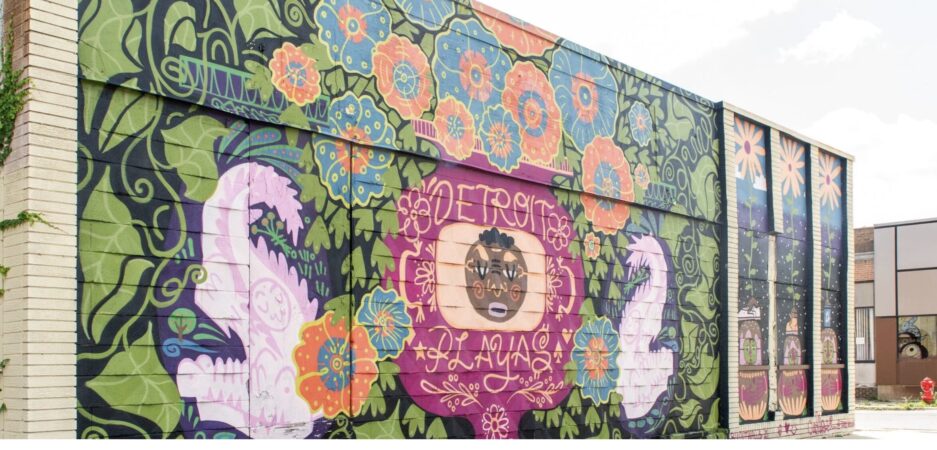
BOYER CAMPBELL BUILDING
Their different backgrounds helped shape the idea for the Detroit Design District, bringing Bergman’s experience in art and design together with Patt-Zamir’s work in architecture and real estate development.
The idea began to take shape as Patt-Zamir traveled and spent more time in the art world. On art tours, she kept encountering collectors from Metro Detroit, even as she noticed that many were not collecting work by Detroit artists.
“We thought that was crazy,” Bergman says. “There is so much art in Detroit. How do we connect these dots?”
Patt-Zamir eventually had a vision – starting with the Boyer Campbell Building which was a Method project – communicated it to Bergman and they were off and running.
In terms of why Detroit and why Milwaukee Junction, Bergman says along East Grand Boulevard and the surrounding streets, she sees the opportunity to create an experience that extends across the neighborhood rather than existing inside a single destination. The goal is for visitors to move through the district, encountering art, design, food and businesses along the way.
“Detroit is horizontal instead of vertical,” she says.
She also talks about Milwaukee Junction as a neighborhood that maintained a creative pulse even through some of Detroit’s most difficult decades.
“The people and the voices and the needs of this neighborhood will instruct how we proceed,” she says. “We’re not going to be successful if we come in and tell them.”
That has meant spending time listening before deciding exactly what the district should become.
“A lot of what we do is not coming in with a plan. It’s coming in to listen,” Bergman says. “We’re not trying to change the neighborhood. We’re trying to enhance what is already there.”
The Boyer Campbell building gives the Detroit Design District a physical place to put some of those ideas into practice. She sees potential for exhibitions, events, conferences, artist programming and other opportunities that bring Detroit’s creative community together while drawing visitors into the neighborhood.
The scale also gives DDD room to evolve. Bergman acknowledges that the exact shape of the district will continue to change as the organization learns what artists, designers, residents and businesses need.
“It’s a big project,” she says. “You have to think big, pivot along the way. Detroit can handle it.”
That vision includes a broad definition of design, with architecture, development, art and other creative disciplines working alongside one another. It also creates a natural connection with Method Development, where Patt-Zamir serves as principal. Method provides the development and architectural side of that relationship, while DDD brings art, design and cultural programming into the equation. The two will collaborate on select projects, including an upcoming downtown hospitality development where DDD is curating art for public spaces.
For Bergman, however, the larger goal remains centered on Detroit: creating more opportunities for people to experience and purchase the work of local artists and designers while allowing the neighborhood to help determine how the district evolves.
“We’re not trying to change the neighborhood,” Bergman says. “We’re trying to enhance what is already there.”
As always, be sure to subscribe to our newsletter for regular updates on all things Detroit and more!