
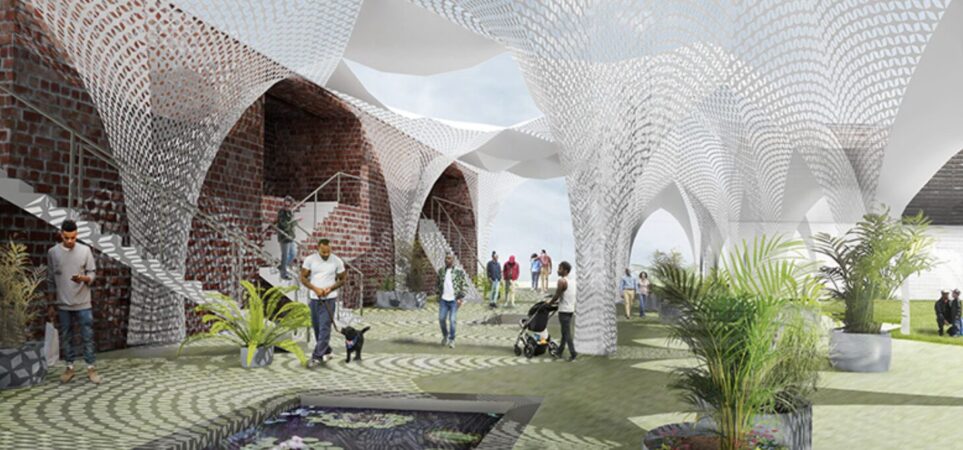



American Riad began with an ambitious idea: bring artists, residents and organizations from Detroit and around the world together to create a space centered on art, community, and shared ownership in the North End.
Over time, that vision has evolved, shaped by the people who have used the space, the programming it has supported and the changing needs of the neighborhood around it.
For Jamii Tata, a North End resident and president and CEO of the Oakland Avenue Artists Coalition (OAAC), the project has always been part of something larger. OAAC has spent years working toward a continuous arts and culture corridor along Oakland Avenue, bringing together artists, residents, business owners, and community organizations around spaces for performances, exhibitions, businesses, and neighborhood events.
American Riad became a piece of that larger vision.
“We were entertaining the idea of what is that hub, or multiple hubs, for an art park in the North End,” Tata said.
The project grew through a partnership that included artist Christopher Robbins and Ghana ThinkTank, which uses an unusual model of taking problems identified in developed countries to communities elsewhere in the world and bringing their proposed solutions back to the original communities.
Conversations in the North End centered on what residents, artists and neighborhood organizations saw as pressing needs and opportunities. Tata said one idea resonated strongly: architecture that encouraged people to interact with one another.

“In America, you can pass away next door and no one even knows,” Tata said. Our counterparts in Ghana told us that’s simply not possible there – that architecture and public spaces naturally facilitate community. “We were like, ‘Yes. We want that.’”
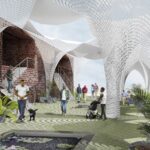
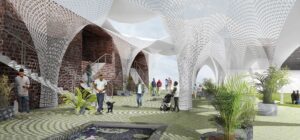
The idea was to create a riad, inspired by the traditional Moroccan home organized around a central courtyard. At the time, the Oakland Avenue site included vacant land and two homes that were available for sale, creating the possibility of combining communal outdoor space with residential and commercial uses.
For OAAC, ownership was an important part of the conversation from the beginning. The goal was to put the land into a community land trust so the neighborhood could retain control of the property over time.
That connected American Riad to larger questions around housing justice and neighborhood development as investment returned to parts of Detroit.
“In the past we had been at the table, but not really at the table,” Tata said of community organizations and residents. “We had been tapped into to use our presence and check a box, but not fully listened to.”
The vision for the American Riad gave neighborhood residents a more direct role in creating the space. Tata was particularly intent on involving young people, who participated in workshops and helped with construction, including assembling scaffolding alongside other members of the project team.
That involvement was important because OAAC did not want the Riad to function as a stand-alone art installation brought into the North End. It needed to become part of work already happening along Oakland Avenue.
Tata thinks about that ongoing work in terms of “placekeeping.”
Building something is one step. Maintaining it, programming it and continuing to make people feel at home there require another level of work.
“Once you get up one thing, keeping it and maintaining it is hard,” he said.
Over the years, American Riad has hosted a wide range of projects that reflect that approach. International artists brought through the Ghana ThinkTank partnership have worked with Detroit artists and neighborhood youth. An outdoor oven became part of a collaborative mosaic project. Artists and young people have filled cracks in sidewalks through art projects, participated in woodworking workshops and explored how discarded materials such as pallets can be reused.
The house adjacent to the courtyard has also supported artist residencies, while the Riad itself has hosted conversations around housing justice, youth programming, literary events, music and performances.
Tata’s own son, a three-time published author, has participated in programming there, including an event that brought literary and music projects together on the Riad stage.
OAAC has also incorporated the space into its annual North End Urban Expressions Art Festival, using the courtyard for evening performances in recent years.
“At the heart of who we are, we’re a grassroots bunch,” Tata said. “If you put us in the space, we’re going to have some fun.”
Parts of the original vision remain unfinished. Funding was not secured to rehabilitate the mixed-use residential and commercial structure that organizers initially hoped would become part of the development, and the building was eventually demolished.
Tata would still like to see housing and small-scale commercial uses return to the property. That idea connects directly to Oakland Avenue’s history as a once-busy commercial corridor, where businesses and residences frequently existed side by side.
He sees potential for one or two mixed-use spaces that could support both housing and entrepreneurship while remaining connected to the Riad and the larger arts corridor.
A strong community land trust capable of holding and maintaining the property long term is also central to that vision.
“Seeing it still there is number one, whatever form it may take,” Tata said.
What happens within the space may continue to evolve. Tata has discussed incorporating elements for skateboarding and finding new ways to connect American Riad with other arts and cultural events. He is especially interested in giving younger residents room to decide what the next version should be.
That could mean a major project or simply giving someone the space to test an idea for a day.
“Some of us are older and burnt out and leaving this earth,” Tata said. “Young people have wonderful ideas and vision to do something with that space. Even if it’s just for a day, do that. Pitch that idea.”
For Tata, continuing to offer that platform to young people, artists and residents is part of keeping American Riad rooted in the North End as the neighborhood around it continues to change.
“Being able to offer platforms to youth and residents and community, and make folks feel welcome in Detroit,” he said, “that’s what I would like to see.”
As always, be sure to subscribe to our newsletter for regular updates on all things Detroit and more!